World mountain's news - Page 2
Arkhyz: ski resort with a past gets a reset. VIDEO
Elbrus.
Vsevolod Pulya. The first chair lift and two trails opened March 18 in the North Caucasus resort of Arkhyz. Alexander Khloponin, presidential envoy to the North Caucasus Federal District, was the first skier to come down the slopes. In a ...
Vsevolod Pulya. The first chair lift and two trails opened March 18 in the North Caucasus resort of Arkhyz. Alexander Khloponin, presidential envoy to the North Caucasus Federal District, was the first skier to come down the slopes. In a celebratory speech afterwards, he noted that while this was certainly a signal event, “there is still much more to do.”
Jam made from pine cones, Cossack fur hats, mountain herbs for tea drinking, sweet homemade wine: these are the sorts of souvenirs tourists bring back from Arkhyz. At local stands they can also buy refrigerator magnets showing snowboarders and skiers against dramatic mountain backdrops. In reality, however, there aren’t any ordinary skiers on the slopes yet. Construction of the Arkhyz Resort has only just begun: instead of hotels there are improvised camp sites, there is almost no cell phone coverage, and there was no point paving the 8.5 miles road to the resort ahead of Sunday’s opening since the heavy construction trucks would destroy it in a matter of weeks.
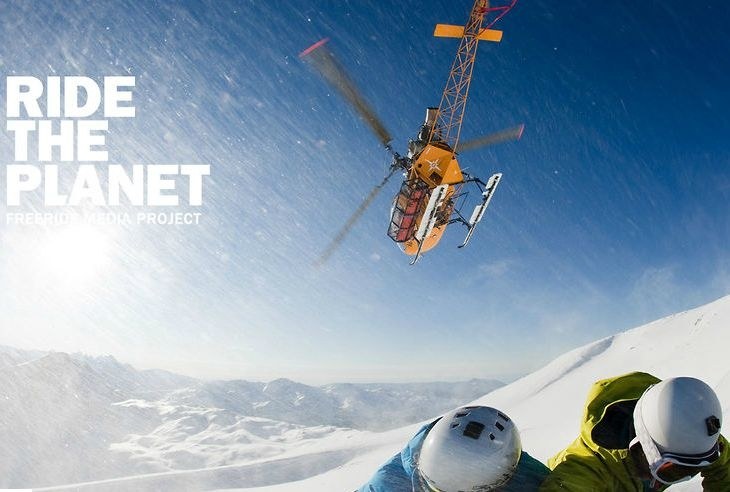
Before the construction began, the only people who came here in winter were extreme skiers with plenty of money – or at least enough to hire a helicopter to drop them at the top of Arkhyz’s virgin trails. In the summer, mountain biking and rock climbing without the necessary infrastructure attracted only the daredevils.
But Arkhyz, which gets some name recognition from a widely distributed mineral water of the same name, is a resort with prospects. In the local dialect, Arkhyz means “beautiful girl,” and a glance at the landscape is enough to see why. Arkhyz is also in a very convenient location: less than four hours by air from most countries in Europe, Asia and the Middle East. The nearest international airport, in Mineralye Vody, is only 125 miles away; the region also plans to build some smaller airports for private planes.
A Russian Les Arcs
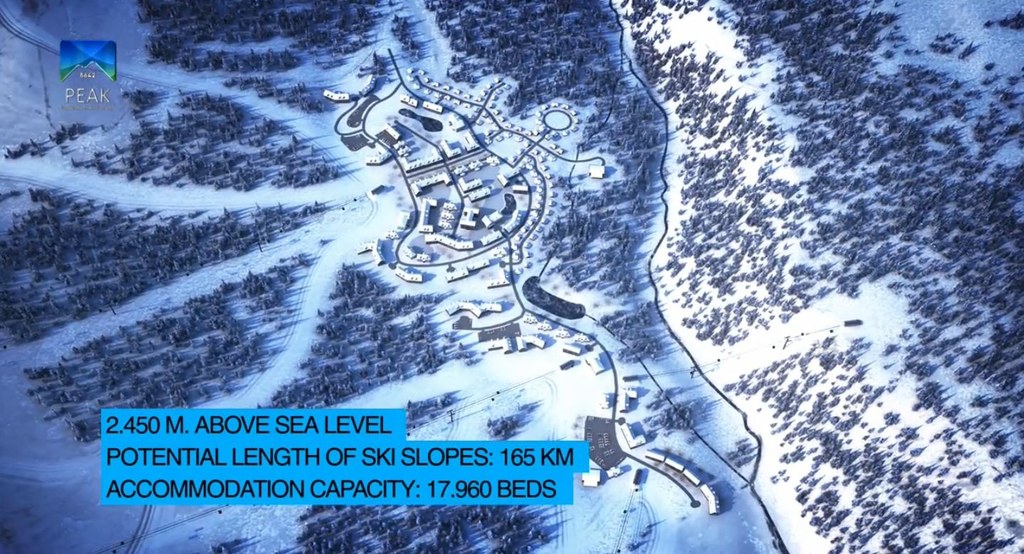

Many of those who attended the opening ceremony at Arkhyz sported hats and scarves bearing the Latin words per angusta ad augusta, which means “through ravines to the heights.” The real heights at Arkhyz are still to be scaled. The new four-seat chairlift takes skiers up only 377 feet, to an altitude of 5,800 feet; the resort itself sits at an altitude of 5,400 feet above sea level. The first two trails are 2,200 and 3,600 feet long. The next stage — construction of five hotel complexes with 700 rooms – will be completed by this fall, in time for the start of the new ski season. By then, the combined length of open ski trails will be almost four miles. These figures may seem modest to inveterate downhill skiers, but these are just trial balloons. Arkhyz has more ambitious plans. “The real work on this resort will begin at the end of the year when we propose specific sites to investors,” Khloponin declared at a post-ski press conference.
Related :
The Caucasus – Ancient traditions and a complex history
Fighting terrorism with tourism
Time to remember, heal and build a good name
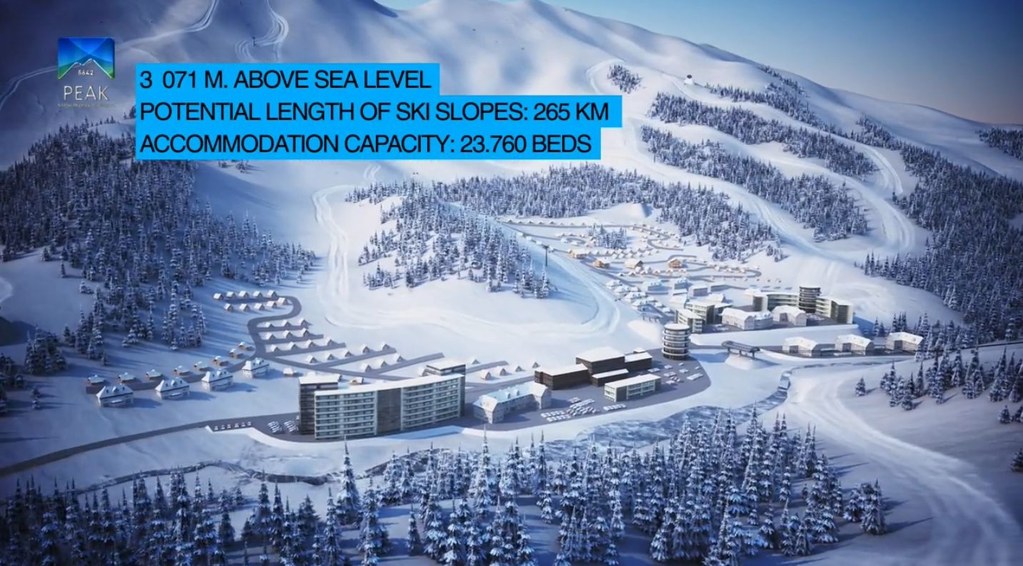
The builders say that when it’s finished, Arkhyz will be comparable to Les Arcs, the French ski resort in the Alps. All told, eight years from now, Arkhyz will consist of four tourist complexes housing a total of 24,000 guests; 54 ski lifts able to carry 45,000 skiers a day; аnd ski trails totaling 167 milres in length. All of this will be available with a single ski pass. At Resorts of the North Caucasus (KSK), the company in charge of developing the tourist cluster in the North Caucasus, specialists say that once Arkhyz is finished and in full operation, it should draw more than half a million skiers a year.
The first goal of the resort is to make downhill skiing affordable for averages Russians. “Resorts in the North Caucasus cluster should not compete among themselves,” said Alexei Nevsky, general director of KSK. “We have to develop a single concept, a single marketing and price policy.”
This project also has a social mission: it will create 10,000 jobs in the Republic of Karacheyvo-Cherkessia, according president of the republic Rashid Temrezov. At any rate, local grandmothers are ready to take in guests: their homemade meat pies and wool socks are already selling well.
Nature and history
Facts and figures
1,440 and 3,300 meters (4,700 feet-10,800 feet) above sea level is the difference in altitudes in Arkhyz Valley. The highest points: Mt. Pshish and Mt. Sophia
60 glaciers and mountain lakes are located in the valley
12 waterfalls crash down from the Sophia Glacier
170 km (105 miles) is the length of the resort’s main waterway: the Zelenchuk River
+14.8 Celsius (58 Farenheit) is the average air temperature in summer
- 5.6 Celsius (21 Farenheit) is the average temperature in winter
0,5-2,5 meters (18 inches-8 feet) is the average thickness of the snow cover
The Arkhyz Gorge is protected from strong winds and blessed with a mild climate. Its alpine slopes are covered with dense stands of fir trees and pine trees and it is the home of 26 natural mineral springs.
Meanwhile, for non-skiing tourists or those who want a break from the slopes, there are some unique local excursions. A mysterious natural icon of Christ is carved right on the steep left bank of the Zelenchuk River. Christ’s face looks down on ancient churches and the remains of the ruined city of Maas. The oldest of the churches was built 1,200 years ago, making it the most ancient religious edifice in Russia.
Thirty-seven miles to the west of Arkhyz is Adyukh Mountain, which has a small tower on its summit. The mountain and its fortress were named in honor of a girl who, as legend has it, was so unhappy in love that she threw herself off the mountain top; another legend claims that she threw off the rope ladder on which her unfaithful lover, a horse thief, was climbing. Visitors able to climb the 730 steps up to the top will be rewarded with a magnificent view of the Zelenchuk River and surrounding valley — the horizon stretches away to Abkhazia.
At the foot of Mt. Adyukh is the Adyukh Palace Hotel, whose owner is a veteran collector of antique automobiles. His collection includes a 1950s Mercedes, and old UAZ that has not driven even one mile in all its 40 years of existence, and a complete collection of Volgas, Chaikas and ZIMs.
A new cluster
The Legend of Caucasus - watch video
Arkhyz is KSK’s debut project. By 2020, KSK plans to have fully developed this tourist cluster with world-class ski resorts throughout the North Caucasus. Meanwhile, Dagestan’s Caspian Sea coast will be dotted with beach resorts. When construction of the cluster is complete, it will boast a combined total of 680 miles of downhill ski trails and 227 ski lifts, as well as hotels, apartments and cottages for 102,500 people.
Northern Caucasus resorts map + info. Click to view infographics
KSK anticipates that this cluster will receive between 5 and 10 million vacationers every year. The total volume of federal investment in the transport infrastructure and communications of resorts in the North Caucasus should equal 60 billion rubles ($20 billion). The Sinara Group, an investor in and builder of Arkhyz, put up 1 billion of the 3 billion rubles already spent on building the resort and its infrastructure. The project’s financing is being conducted on the principles of a government-private partnership. The project will receive a total of 80 billion rubles ($2.7 billion) in investment.
These Russian investors are expected be followed by foreign investors; investors from France and South Korea have already signed agreements on a joint enterprise, according to Nevsky. He confirmed that the South Korean company Korea Western Power is ready to invest $1 billion in the cluster’s electricity supply network, while the investment bank Singapore Nexus means to invest in the development of hotels.
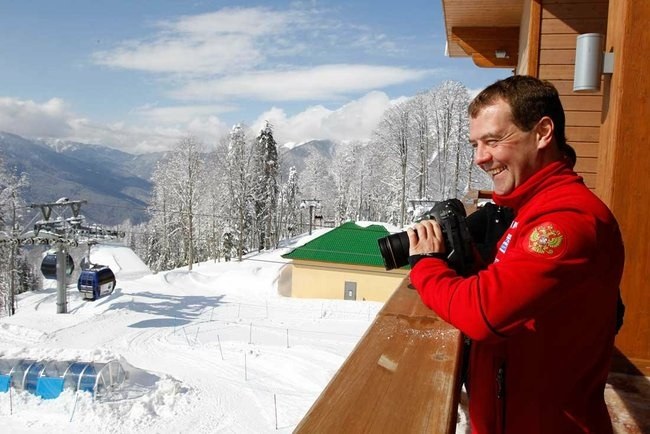
President Dmitry Medvedev led a meeting dedicated of tourism in the Northern Caucasus
Elbrus.
Today (11.03. 2012) Krasnodar hosted a meeting chaired by Russian President Dmitry Medvedev dedicated to the development of Russian resorts. The meeting was also attended by Deputy Prime Minister of Russia Alexander Khloponin, Economic ...
Today (11.03. 2012) Krasnodar hosted a meeting chaired by Russian President Dmitry Medvedev dedicated to the development of Russian resorts. The meeting was also attended by Deputy Prime Minister of Russia Alexander Khloponin, Economic Development Minister Elvira Nabiullina and Minister of Sport, Tourism and Youth Policy Vitaly Mutko, as well as heads of the regions of South and North Caucasus districts and representatives of foreign companies.
After receiving the data from Vitaly Mutko that only 59 subjects of the Russian Federation have developed a tourism program, Dmitry Medvedev has demanded to develop a realistic program for the development of tourism in every region of the Russian Federation, stressing that "there should be mutual responsibility."
The leaders of Dagestan and Ingushetia asked the president to increase the authorized capital of the "Resorts of the North Caucasus" in connection with the recent inclusion of these two republics in the program, RIA Novosti reports. Medvedev instructed the Minister of Economic Development Elvira Nabiullina to prepare a final report with calculations of how much money will it take to develop resorts in the two republics.
Nabiullina promised to prepare a report, but added that according to the preliminary assessment, "the inclusion of Dagestan in this program will cost about 40 billion rubles from the federal budget alone."
Russian President Dmitry Medvedev supported the presidential envoy to the North Caucasus Federal District Alexander Khloponin on the need to develop the Caspian coastal area with beach resorts.
The participants of the meeting discussed a wide variety of issues related to the development of tourism in Russia.
France ready to invest in N Caucasus
French companies are prepared to massively invest in helicopter building and also in the hospitality and holiday industries on Russian territory.
French presidential envoy for Russia ties Jean-Pierre Thomas spoke about this at a meeting with President Dmitry Medvedev in Krasnodar in southern Russia on Sunday.
He sits on the board of a joint company which is hoping to attract at least $10bn worth of investment in the holiday industry in the Russian Caucasus.
(TASS)
Russia developing resorts in the North Caucasus
Foreign companies have invested over 3 billion U.S. dollars to develop resorts in the North Caucasus. Russian investors have contributed almost a similar amount. Russian President Dmitry Medvedev revealed these figures addressing a conference in the southern Russian city of Krasnodar dedicated to promoting tourism in the North Caucasus.
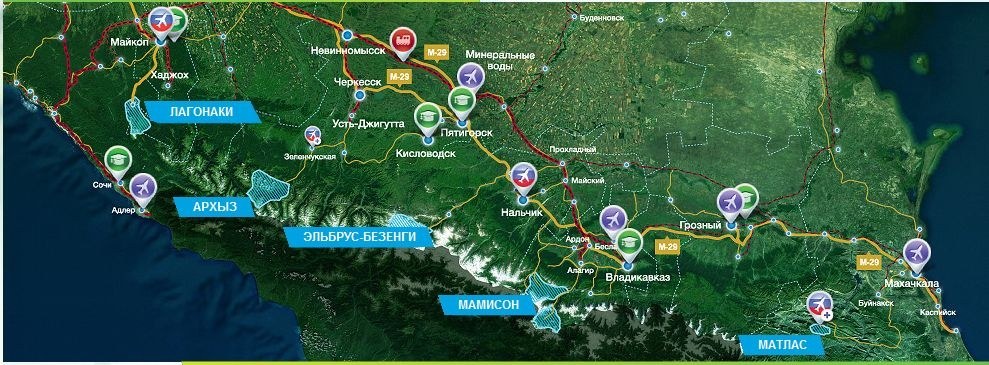
Several resort zones in Southern Russia united under the “Resorts of the North Caucasus” will be turned into winter sports and year-round resorts. These zones are Lagonaki, a beautiful plateau located in Krasnodar region and Adygee, Arkhyz in Karachaevo-Cherkesia, Elbrus-Bezengi in Kabardino-Balkaria, Mamison in Northern Ossetia-Alania, Matlas in Dagestan and Tsori and Armkhi in Ingushetia. A network of resorts will also appear along the Caspian Sea shore in Dagestan.
The “Resorts of the North Caucasus” are a grandiose project in terms of territory and the amount of construction work. The overall length of Alpine ski runs exceeds 1,100 kilometers. Despite difficulties, many investors, especially foreigners, expressed readiness to go into this project. This has become possible owing to the businesslike work of the government which has done a lot to attract investors and partners, says Dmitry Medvedev.
“A government mechanism supporting the project was developed and amendments were made to the federal law on special economic zones in the Russian Federation. This law paves the way for solving the most difficult tasks. There was no such mechanism before. The residents of tourist and recreation type economic zones in the North Caucasus enjoy tax and duty breaks. Concrete results of this activity can be seen even now. The construction of the year-round resort of Arkhyz is in full swing, and it plans to receive tourists in the winter season of 2012. Construction of other resorts is now underway,” says Dmitry Medvedev.
At present, some of the tourist projects in the North Caucasus have already worked out their business plans with leading foreign companies. Among these are the French bank Caisse des Depots et Consignations, South Korea’s state-run energy company Western Power and companies in Singapore. The prestigious MIRIM Asia Awards-2011 International Developers competition assessed the project, describing it as the best project for the future.
Despite the rosy picture there are many problems related to the involvement of investors and the launch of construction, says Dmitry Medvedev.
“Among these problems are providing the resorts with contemporary infrastructures, their transport accessibility, the construction of roads, railways and airports. All this is very important for the attraction of tourists to the North Caucasus and the Caspian Sea. We will have to reconstruct at least 6 existing airports and build four new ones. It’s crucial to increase the passenger flow. At present, the capacity of the airports in North Caucasus is about 20,000 passengers a day. But this figure has to be increased five times to implement the large project, Dmitry Medvedev said.
The “Resorts of North Caucasus” is a very expensive project. It is financed under the principle of government and private partnership. At present, only a part of the necessary amount has been collected. According to experts, investments in the North Caucus tourist project will be paid off in 5-10 years. In short, the profitability of the project is up to 15 percent.
Maria Khitrikova dies on Mount Elbrus
Elbrus.
On 4 March 2012 the body of Ukrainian mountaineer Maria Khitrikova was discovered of Mount Elbrus, Russia. The news of young (a mere 21 years old) Ukrainian alpinist Maria Khitrikova whose body was discovered yesterday on Mount Elbrus, at ...
On 4 March 2012 the body of Ukrainian mountaineer Maria Khitrikova was discovered of Mount Elbrus, Russia.
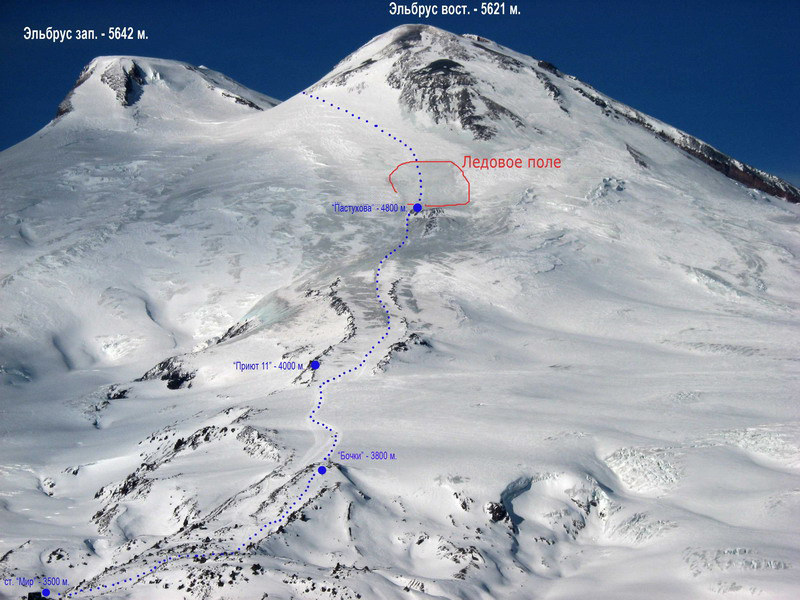
The news of young (a mere 21 years old) Ukrainian alpinist Maria Khitrikova whose body was discovered yesterday on Mount Elbrus, at 5642m the highest peak in Russia, comes directly from journalist Anna Piunova. Maria was guiding a group of alpinists and had summited Elbrus on 2 March when she waited for two companions who had fallen behind in poor conditions. One of these, Roman Kutsiy, has been rescued and transported to hospital while the search is still underway for Denis Lisov. For Maria though, as Anna Piunova recounts, unfortunately no hope remained.
"Two groups of 11 Ukrainian mountaineers summited Elbrus on March, 2nd. They were caught in poor weather on their way down and two dropped behind. Maria Khitrikova, who was guiding one of the groups, stopped and waited for them while the rest of the party successfully descended. Several hours later Maria was able to telephone the rescue services to say that they had lost their way. Poor weather meant that the helicopter could not be sent, however the rescuers set out in search.
During the next evening the rescue team located Roman Kutsiy (at 4200m?), one of the two guys Maria had waited for. He was evacuated to hospital and was diagnosed angina pectoris after spending a cold night and day lying down on a snow flank and eating snow. Details are currently unclear, but according to Roman they untied after three repeated falls, the terrain was icy and Maria lost one of her crampons. They all were depressed and ready for the worst.
Her father, the famous alpinist Vladimir Khitrikov, arrived late night on March, 3. During the next afternoon Maria's body was found at approximately 4700m to the left of the Pastukhov Cliffs. The rescue of Denis Lisov is under way.
21 year-old Maria Khitrikova was the daughter of the Soviet Union Champion Vladimir Khitrikov. She was the big hope of Ukrainian Mountaineering, one of the country's most talented and promising female climbers. Considered the "Wondergirl of high altitude mountaineering", she summited Elbrus aged 12, her first 7000er aged 16, her first 8000er aged 21. She won the Elbrus Race and climbed Pik Lenin (7134m), Khan Tengri (6995m), Ama Dablam (6812m), Pik Korzhenevskoy (7105), Gasherbrum I (8035m) and Gasherbrum II (8068m)."
Anna Piunova, www.mountain.ru

Elbrus invites athletes and all mountain amateurs
Elbrus.
Welcome to Elbrus! Now Prielbrusie region, ie, the southern slopes of Mount Elbrus, is completely open to the public. In early May, the company Red Fox plans to hold a massive competition. Hundreds of athletes, mountain fans will come to ...
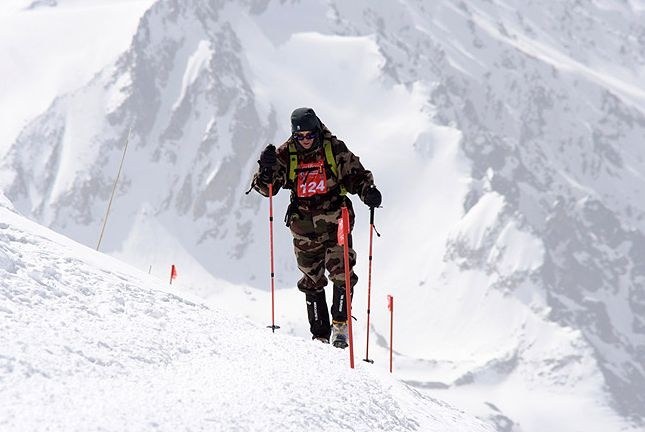
Welcome to Elbrus! Now Prielbrusie region, ie, the southern slopes of Mount Elbrus, is completely open to the public. In early May, the company Red Fox plans to hold a massive competition. Hundreds of athletes, mountain fans will come to the mountain slopes of Mount Elbrus, to compete in several types of competitions. Race is included in the international calendar of the International Federation of mountain races (ISF). This is the first start of the World Series. We are waiting for the world leaders.
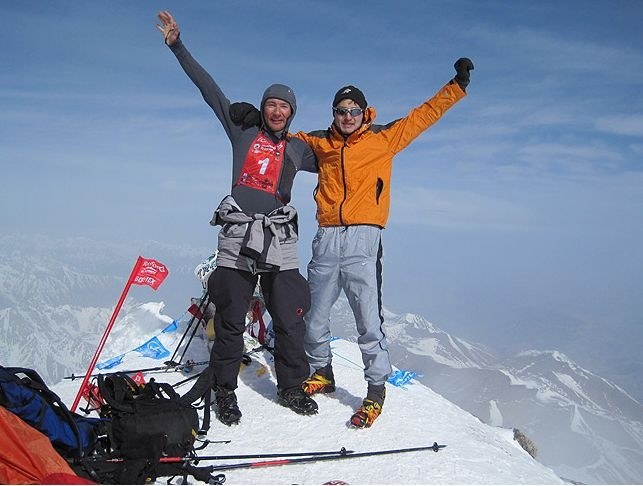
Elbrus - the highest mountain in Europe, is waiting for you ! Climbing is a unique, with beautiful scenery, and you will remember for a lifetime.
For the first time professionals and amateurs will start separately. Amateurs will start up to the summit, like all previous years, from the shelter of "Barrels" (3800 meters), and professionals - from the Clearing Azau (2350 meters).
Vertical kilometer same as before, will be from the Clearing Azau to shelter "Mir"
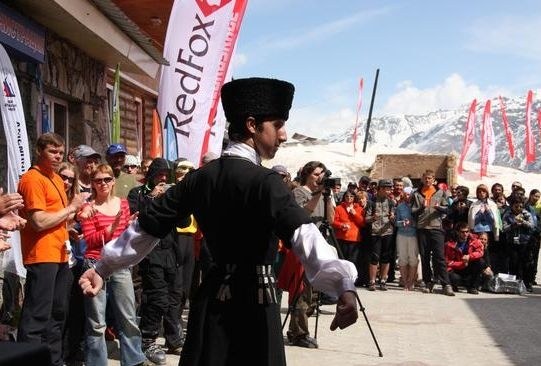

We wait your application on the IV International Festival of extreme sports Red Fox Elbrus Race 2012!
http://www.elbrus.redfox.ru/english/
Red Fox company together with Russian Mountaineering Federation conduct IV International festival Red Fox Elbrus Race on May 6-11, 2012.
The competition will take place on the Elbrus peak, the highest top of the Europe and the most popular Russian mountain region.
You can fill the Application here
http://www.elbrus.redfox.ru/english/zayavka/
The preliminary applications can be sent by e-mail in the attached excel file. E-mail: elbrus@redfox.ru. It’s obligatory to indicate last name, age and discipline of the competitions and qualification.
The preliminary applications are accepted until 20 April 2012 with obligatory confirmation.
Program:
6th May
11-00-19-00 Registration. Glade Azau.
19-00 Briefing of the Elbrus Vertical Kilometer® (2012 Vertical Kilometer® Series).
7th May
9-00 Elbrus Vertical Kilometer® (2012 Vertical Kilometer® Series).
14-00 Inauguration of the Festival.
Awarding ceremony of the winners of the Elbrus Vertical Kilometer®.
19-00 Briefing of the ski-mountaineering personal race.
8th May
9-00 Ski-mountaineering personal race.
14-00 Awarding ceremony of the winners of the ski-mountaineering personal race.
19-00 Briefing of the Elbrus Vertical SkyRace® (2012 SkyRace® Series).
9th May
7-00 Elbrus Vertical SkyRace® (2012 SkyRace® Series).
19-00 Briefing of the snow-shoes race.
10th May
10-30 Snow-shoes race.
15-00 Awarding ceremony of the winners of the Elbrus Vertical SkyRace® and of the snow-shoes race. Closing ceremony of the Festival.
11th May
Reserve day.
You are welcome!

Ingushetia And The Caspian Coast Are Added To The North Caucasus Tourism Cluster
Elbrus.
Russian Government decided to expand the North Caucasus tourism cluster. The resolution № 1195 "On special economic zones in the North Caucasus Federal District", dated 29 December 2011, was published on the site of Russian Government. In ...
Russian Government decided to expand the North Caucasus tourism cluster. The resolution № 1195 "On special economic zones in the North Caucasus Federal District", dated 29 December 2011, was published on the site of Russian Government.
In particular, Russian Government decided to create a special economic zone for tourism and recreation in the areas of Dzheyrahsky and Sunzha districts of the Republic of Ingushetia. The Ministry of Economic Development of Russia will sign on behalf of Russian Government an agreement with the Government of the Republic of Ingushetia and with the administrations of Dzheyrahsky and Sunzha districts of Ingushetia.
In addition, at the suggestion of Ministry of Economic Development of Russia is decided to increase the area of previously established under the RF Government Resolution № 833 from October 14, 2010 tourist-recreational special economic zones.
In particular, the special economic zone in the Republic of Dagestan, previously bounded by Hunzah area, will be expanded by Derbent, Karabudakhkent, Kaiakent and Magaramkentsky areas.
SEZ in the Karachai-Cherkess Republic, which was bounded by Zelenchukskaya area, will include Urupskiy area.
SEZ in Kabardino-Balkaria Republic, located on the territory of Cherek, Elbrus and Chegem areas will complement the land of another area - Zolsky.
The Ministry of Economic Development of Russia will sign on behalf of the Government of the Russian Federation appropriate supplemental agreements amending the previously concluded agreements on the establishment of tourist-recreational special economic zones with the highest executive authorities of Russian regions and executive and administrative bodies of municipalities.
*** The formation of special economic zones for tourism and recreation in the south of Russia goes under the control of OJSC "Northern Caucasus Resorts” in accordance with Government Resolution № 833, dated October 14, 2010 "About creation of the tourism cluster in the North Caucasus Federal District, Krasnodar Territory and the Republic of Adygea". The document envisaged the creation of six tourist-recreational special economic zones in southern Russia for the construction in 2011 - 2020 years of the five new world-class ski resorts - Lagonaki (Krasnodar territory and the Republic of Adygea), Arkhyz (Karachaevo-Cherkessia), Elbrus-Bezengi (Kabardino-Balkaria), Mamison (Republic of North Ossetia - Alania) and Matlas (Republic of Dagestan).
http://www.ncrc.ru/e/news/index.php?id_4=387
Russia and France Have Registered The Joint Venture For Tourism Cluster
Elbrus.
Russia and France have officially registered the joint venture for the development of the North Caucasus tourism cluster. The joint venture, called International Caucasus Development, will begin to work in February 2012. According to the ...
Russia and France have officially registered the joint venture for the development of the North Caucasus tourism cluster.
The joint venture, called International Caucasus Development, will begin to work in February 2012. According to the shareholder agreement, which was signed by the parties, joint venture plans to bring in 2012 into the tourism cluster of up to 1 billion euros of investments.
The authorized capital of joint venture will be 10 million euros, of which 51% - will be the share of "NCR" corporation and 49% - of the French side. The Board of Directors will consist of four representatives from each of the parties and will be headed by a representative of the Russian side. Director General of Joint venture will be a representative of France. For a comprehensive assessment of investment projects under the joint venture will be established Technical Board, which would include leading experts from Russia and France.
The joint venture will carry out international coordinating role for the development of the concept and construction of the North Caucasus tourism cluster. The venture will create a system of sales of investment products, will develop business plans for the project and will involve foreign investors. Joint venture will also make a comprehensive review of all projects being prepared for implementation and will transfer them to international standards of quality in all parameters - economic, environmental, technical, social, infrastructure, architecture, etc.
According to the French side, this approach will allow Joint venture to raise up to 15-20 billion euros of foreign investments in the projects of North Caucasus Federal District.
The initiative of joint work in the North Caucasus belongs to the Russian and French presidents Dmitry Medvedev and Nicolas Sarkozy. On May 26, 2011 at Deauville, the two leaders made a statement in which the joint development of resorts in the North Caucasus has been identified as a strategic priority of the Franco-Russian strategic partnership.
In this initiative, on June 17, 2011 OJSC "Resorts of the North Caucasus" and Caisse des Depots et Consignations have signed a framework cooperation agreement, in September 2011 – pre-shareholder agreement and on 9 December 2011 in Brussels was signed a shareholder agreement establishing the joint venture. As a result the company was officially registered in Netherlands.
The project of the tourism cluster in the south of Russia in 2011-2020 includes the construction of five world-class mountain resorts: Lagonaki (Krasnodar Territory, the Republic of Adygea), Arkhyz (Karachay-Cherkessia), Elbrus-Bezengi (Kabardino-Balkaria), Mamison (Republic of North Ossetia - Alania), Matlas (Republic of Dagestan). The planned total length of ski runs will be almost 900 km and they will have 179 ski lifts. The hotels with varying comfort levels will accommodate 89 000 people. Daily throughput of the resorts will reach 150 500 people and each year the North Caucasus tourist cluster will be visited by 5 to 10 million tourists. The project involves phased implementation of over 330 thousand jobs in the region.
The total cost of the ski project is estimated at 451 billion rubles. The project is financed by a public-private partnership. Government invests via NCR 60 billion rubles in transport and utilities infrastructure, private business is financing the facilities of resort infrastructure.
Russian government is considering the inclusion of the coastal area of the Caspian Sea (Dagestan), Caucasus Mineral Waters (Stavropol Territory) and the Republic of Ingushetia to the North Caucasus tourism cluster project.

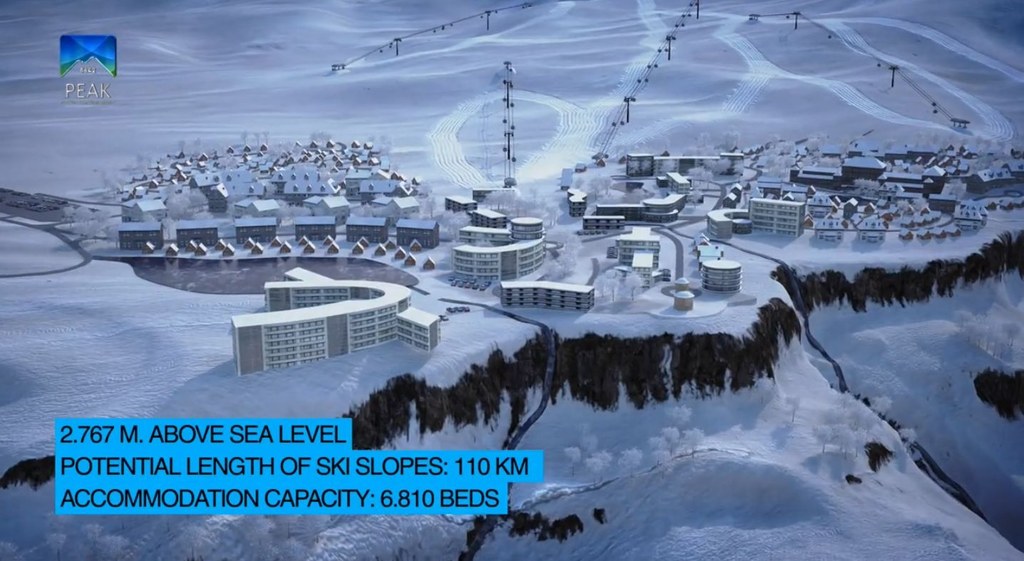
Mega Tourism Resort Project in North Caucasus
Elbrus.
PR Newswire: Mega Tourism Resort Project in North Caucasus Mountains Becomes First Russian Entry to Win a Prestigious International Commercial Real Estate Development MIPIM Award HONG KONG. /PRNewswire/ -- The development company overseeing ...
PR Newswire: Mega Tourism Resort Project in North Caucasus Mountains Becomes First Russian Entry to Win a Prestigious International Commercial Real Estate Development MIPIM Award
HONG KONG. /PRNewswire/ -- The development company overseeing construction of a massive system of ski, beach and natural health spa resorts covering 50,000 sq km in the North Caucasus Mountains, stretching 1,200 km from the Caspian Sea to the Black Sea and bordering Asia, was named the first Russian winner ever of a renowned MIPIM global real estate competition.
|
Caucasus - one of the most beautiful mountains in the world. We believe in a prosperous future for the region. Most of foreign climbers visit the Mount Elbrus area only. In order to understand what else is there, just look at photos of Mikhail Golubev. Photos of Michail Golubev http://www.photosight.ru/users/192840/?pager=4
Three different view on Elbrus
|
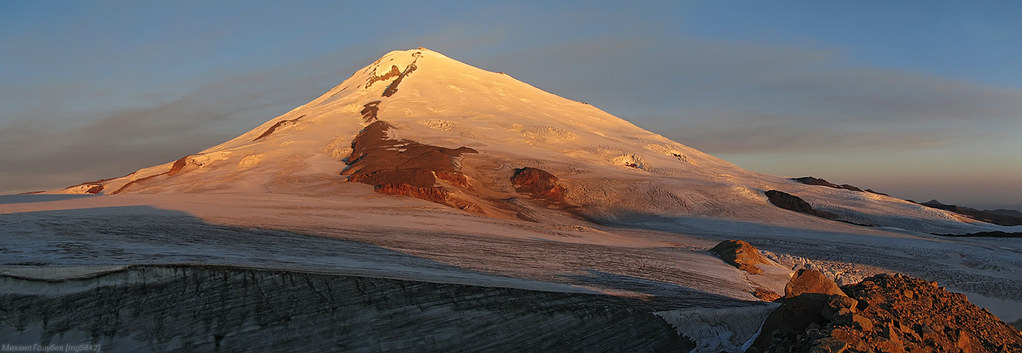

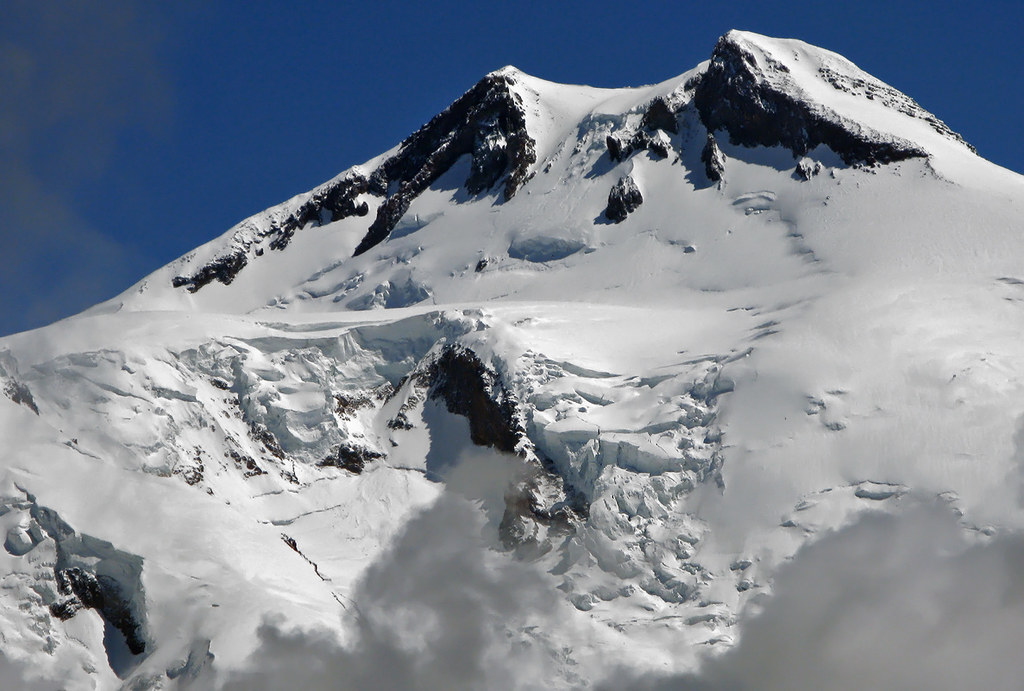
Northern Caucasus Resorts Company (NCRC) executives will accept the award, based on innovative, technical, environmental and architectural merits, in the Central & Western Asia Futura category at the annual MIPIM Asia awards ceremony here on Nov. 16. MIPIM, short for Le Marche International des Professionnels d'Immobilier, is the premier world promoter of the international property trade. Eighty entrants from 15 countries are involved in the contest, including China, Japan, Indonesia, Taiwan, Malaysia and the UAE.
"Asia-Pacific investors seeking to diversify outside their domestic markets to mitigate risk and secure higher returns will find great opportunity within our unique plan for developing a sustainable tourism industry in the mountains on our country's southern border with Asia," said NCRC Chairman Akhmed Bilalov. "We expect many also will be attracted to the chance to participate in the first major step in a proposed new national strategy to use public-private initiatives in tourism to spur much-needed economic growth in depressed regions of the Russian Federation."
Moscow-based NCRC was established last December to drive the massive tourism project, which will create up to 300,000 new jobs. A collaboration with the federal government, the development is part of a long-term strategy to address the economic lag that underlies social tensions in the North Caucasus region. The plan includes industry, agriculture and youth vocational training reform.
With the explicit support of President Dmitri Medvedev, the federal government initially capitalized the bold undertaking with a $2.0-billion allocation for development of transportation, communications, electrical power and other infrastructure. NCRC is actively pursuing investment from financial institutions and global property developers. The ten-year project is anticipated to require up to $30 billion to complete all phases, including a cluster of five world-class skiing and five modern seaside resorts, as well as an array of health spas that will take advantage of the area's legendary healing mineral and hot springs.
To facilitate international and domestic investment, the Russian government has designated the entire 50,000-sq-km development area a special economic zone (SEZ). State guarantees will cover up to 70 percent of investments for three to ten years. The state will impose no corporate or transportation taxes for the first ten years, no land taxes for five years and no VAT tax will be applied on equipment imported into the SEZ. The project offers opportunities for foreign companies interested in hospitality, health and wellness, food and beverage, retail, real estate, logistics and warehousing industries.
"The success of this grand and important project depends on investment being thoroughly diversified and international," said Laurent Vigier, director of European and international affairs for Caisse des Depots et Consignations (CDC). The French state-owned banking group and long-term investor has signed a strategic joint venture with NCRC to provide advanced technical, legal, planning and environmental expertise to support the project. "The current outreach to the Asia-Pacific investment community is a major and critical step toward generating a broad and effective portfolio of investors for the North Caucasus," added M. Vigier, who will join NCRC executives here to present the tourism project.
About 20 French companies have already expressed interest in investing in ski lifts, hotels, airports, mountain tunnel and other construction projects. The first investment from Asia came Nov. 2 in the form of a joint venture with Korean Western Power Company to build up to five power and heating plants in the region, integrating renewable energy sources from wind and solar generation. The investment is worth approximately $1.0 billion.
NCRC's skiing resorts, the centerpiece of the overall project and including the tallest peak in Europe, Mt. Elbrus, will open between Dec. 2012 and Dec. 2015, in time for the 2014 Winter Olympic Games in the neighboring Black Sea coastal town of Sochi. Once completed, the North Caucasus ski cluster will become the world's third-largest ski destination, rivaling famed resorts located in the European Alps and the North American Rockies. With over 2.9 billion people in Russia, Europe, the Middle East and Southeast Asia living within a five-hour flight from the ski resorts, over ten million tourists of various income levels are expected to visit the mountains annually.
Company representatives will be available for one-on-one meetings with representatives of the financial, business and media communities. To schedule a business session, please contact Pavel Achikyan: +7 916 199-5313 or pavel.achikyan@gmail.com; for media interviews contact Mark D'Anastasio, +1 202 550-1235 or +7 985 999-3855, mdanastasio@emcommunicate.com
A video of the ski resort cluster project can be viewed at
For additional information about the company visit www.ncrc.ru. A press briefer can be found on the MIPIM Online Media Center site: http://www.mipim.com/en/mipim-asia/press/press-kits-and-releases/

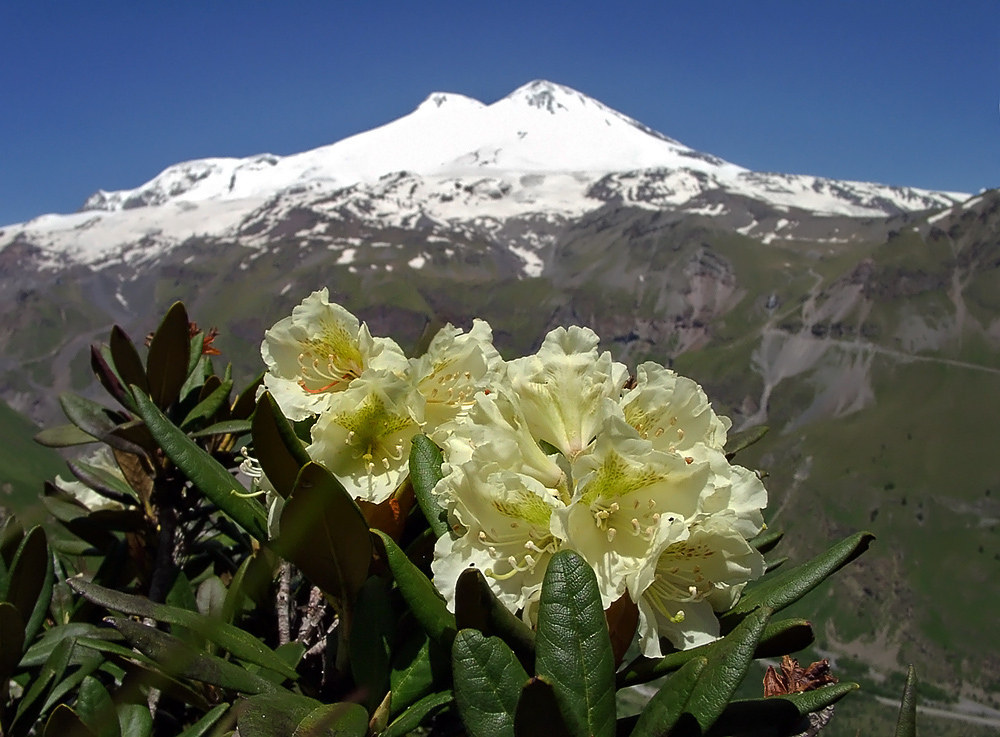
Welcome to the Elbrus region ! CTO is canceled
Elbrus.
Counterterrorist operation (CTO) in the Elbrus and the part of the Baksan regions of Kabardino-Balkaria canceled on November 5. The head of the Kabardino-Balkaria Arsen Kanokov said that the CTO regime will be off to the beginning of winter ...
Counterterrorist operation (CTO) in the Elbrus and the part of the Baksan regions of Kabardino-Balkaria canceled on November 5. The head of the Kabardino-Balkaria Arsen Kanokov said that the CTO regime will be off to the beginning of winter ski season. The CTO regime throughout the Elbrus and the Baksan areas of Kabardino-Balkaria was introduced February 20, 2011.
«…because of continuing threat of subversive and terror acts, the republic keeps all its mountain resorts near Elbrus closed for tourists. In order to prevent possible threats to life and health of people, being guided by Article 11 of the Federal Law 'On Counteracting Terrorism', during a counterterrorist operation (CTO) regime, it was prohibited to let tourist groups and individual tourists to the ski resort near Elbrus, which is inside the CTO area,"
Welcome !
Elbrus - is invaluable pride and property №1 among the main miracles of Russia. The greatest mountain of Europe! One of the seventh of most magnificent highest tops that hold a firmament on different continents of our planet.
The material has been made during small travel to Caucasus and ascension to Elbrus from February till March, 2011. Despite heavy weather conditions, we still were able to embody some beautiful fragments of life of this wonderful mountain.
Enjoy viewing!
video from Vladimir Voychuk
Latest news from JSC "Northern Caucasus Resorts”
03.11.2011
THE AMENDMENTS TO THE LAW ABOUT SPECIAL ECONOMIC ZONES WILL ATTRACT PRIVATE INVESTORS TO THE NORTH CAUCASUS
JSC "Northern Caucasus Resorts” agrees with the changes to the law on special economic zones, which were coordinated with environmentalists. On the November 2 The State Duma at the second reading passed thе version of the legislation that as far as possible ensures conservation of the reserved areas and at the same time privides conditions for the effective development of the touristic zones.
Earlier, Chairman of the Board of Directors of NCR Akhmed Bilalov was categorically against submitted to the Duma edition of the bill and insisted on its correlation with the views of influential environmentalists. "The tabled version of the law is presented as dictated by the needs of the North Caucasus tourism cluster. However, some officials have tried to put into this law all their problems which they did not want to solve for many years. We will ensure, that the changes will affect only those sites that are being developed within the special economic zones for tourism and recreation under strict government control”, - said Bilalov.
During further consultations a mutually acceptable version of the bill was developed. "The new version of amendments accordes with most of the claims of environmentalists," - said in a statement of WWF Russia. "We managed to find formulations that allow the development of environmental management in the biosphere ranges - that is their primary goal, but it does not entail damaging effects as the previous bill project, - said Igor Chestin, director of WWF-Russia.
Akhmed Bilalov expressed his confidence that the accepted amendments to the law on special economic zones will not harm protected areas.and will contribute to the effective development of the North Caucasus region will attract private investors to the tourism projects in the south of Russia.
"The bill provides tax deduction for residents of tourist-recreational SEZ for a period up to 2023, greatly simplifies the form of land use and technical regulations. The preferences, which are established by the bill are extremely attractive for investors ", - said Bilalov. He also reminded that the project of the North Caucasus tourism cluster will create in the region more than 300 thousand new jobs.
*** The project of the tourism cluster in the south of Russia in 2011-2020 involves the construction of five world-class mountain resorts: Lagonaki (Krasnodar Territory, the Republic of Adygea), Arkhyz (Karachay-Cherkessia), Elbrus-Bezengi (Kabardino-Balkaria), Mamison (Republic of North Ossetia - Alania), Matlas (Republic of Dagestan). The planned total length of ski runs will be almost 900 km and they will have 179 ski lifts. The hotels with varying comfort levels will accommodate 89 000 people. Daily capacity of the resorts will reach 150 500 people and each year the North Caucasus tourist cluster will be visited by 5 to 10 million tourists.
The total cost of the ski project is estimated at 451 billion rubles. The project is financed by a public-private partnership. Government invests via "NCR" corporation 60 billion in transport and utilities infrastructure, private business is financing the facilities of resort infrastructure.
The Russian government is considering the inclusion of the coastal area of the Caspian Sea (Dagestan), Caucasus Mineral Waters (Stavropol Territory) and the Republic of Ingushetia to the North Caucasus tourism cluster project.
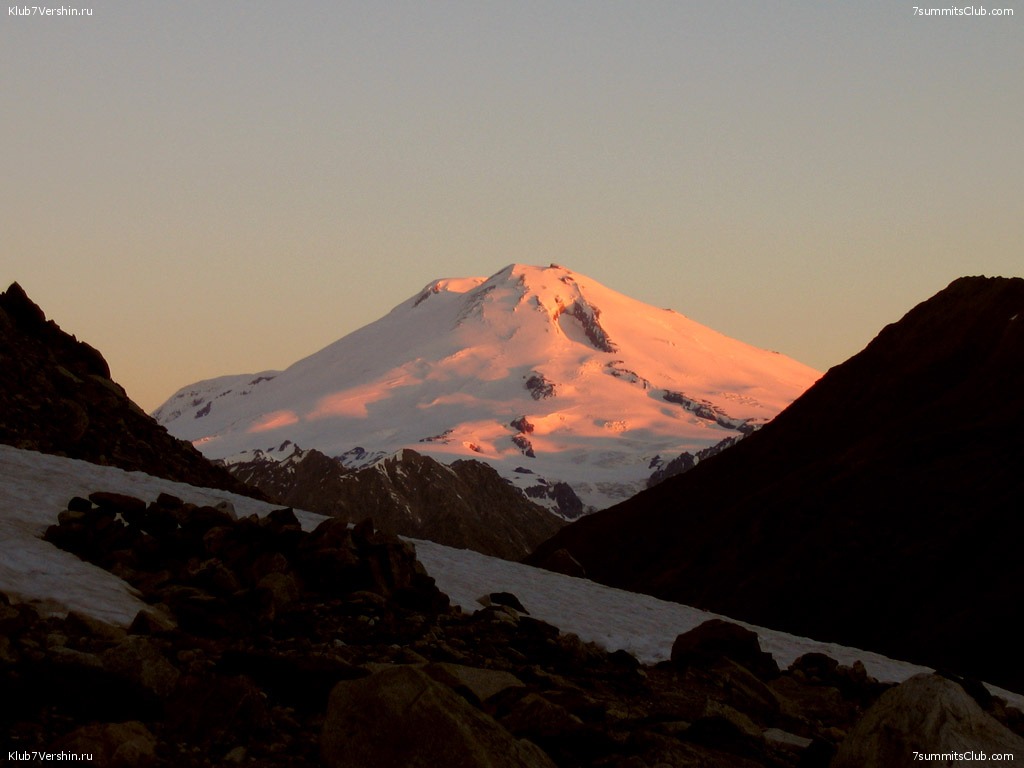
Soon South Elbrus will be open for all
Elbrus.
The southern slopes of Mount Elbrus will be open to all visitors, probably from 1th December. Counter-terrorist operation is not canceled and may be even remain. However, no special restrictions on the visit will be exist. ...
The southern slopes of Mount Elbrus will be open to all visitors, probably from 1th December. Counter-terrorist operation is not canceled and may be even remain. However, no special restrictions on the visit will be exist. Cable cars, damaged by terrorists, are fully restored. Hotels are preparing to meet skiers. In the spring we are waiting for ski tourists, then the race in Elbrus. We hope that next summer will be in normal.
Elbrus area qualifies as a backup venue for ski competitions of the Olympic Games in 2014. Authority promise a beginning large-scale construction works in nearest future.
Fresh pictures from the Elbrus Regin (from risk.ru)
Mount Cheget - an extreme skiers paradize

Majestic Donguz-Orun

Meanwhile, Olympic Organizing Committee announced plans for the torch relay....
Author: Stefan Korshak.
Relay runners will for the first time carry the Olympic flame to the North Pole, Russian organizers of the 2014 Winter Games said on Tuesday.
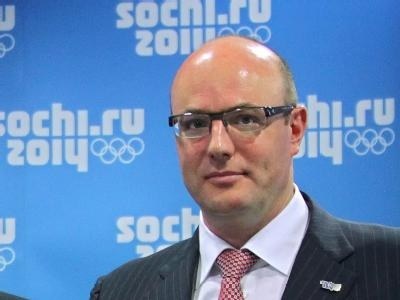
Dmitry Chernyshenko. Archive picture: Yuri Kochetkov
"The most ambitous relay race" ever attempted with an Olympic flame will also take the fire into space and across a 5,000 metre mountain, Dmitry Chernyshenko, head of Russia's Olympic committee, told the news agency Itar-Tass.
A trip for the flame into space, possibly involving the International Space Station (ISS), will be a major challenge, as will be taking the fire to the summit of the 5,642-metre-high Mount Elbrus, Russia's tallest mountain and the highest peak in Europe, Chernyshenko said.
The Olympic flame is scheduled to arrive in Moscow from Athens in October 2013 and then to travel in relays just under 9,000 kilometres to the Pacific port Vladivostok.
In the remaining 123 days until the Olympic Games, running from February 7 to 23, the flame and its carriers will follow a route of more than 40,000km through all 83 major cities in Russia's regions, Chernyshenko said.
More than 30,000 volunteers will participate in the flame relay, he said.
The 22nd Winter Olympic games are scheduled to be held from February 7 to 23, 2014, in the Black Sea port city Sochi and in the adjacent Caucasian mountain resort Krasnaya Polyana.
Independent, Ski visit into Krasnaya Polana
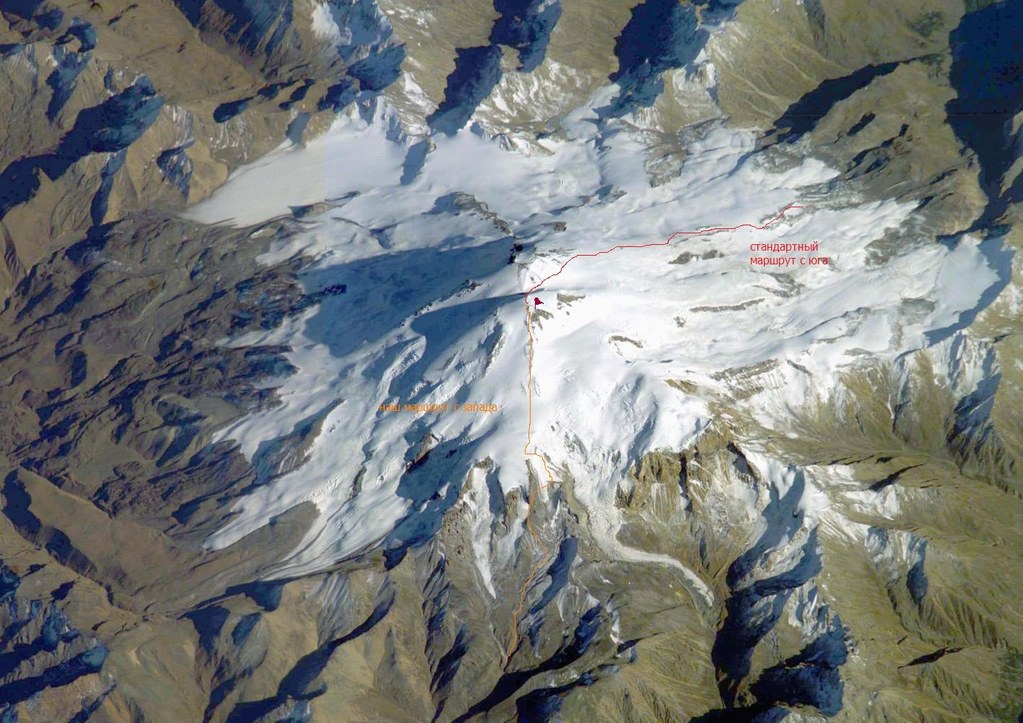
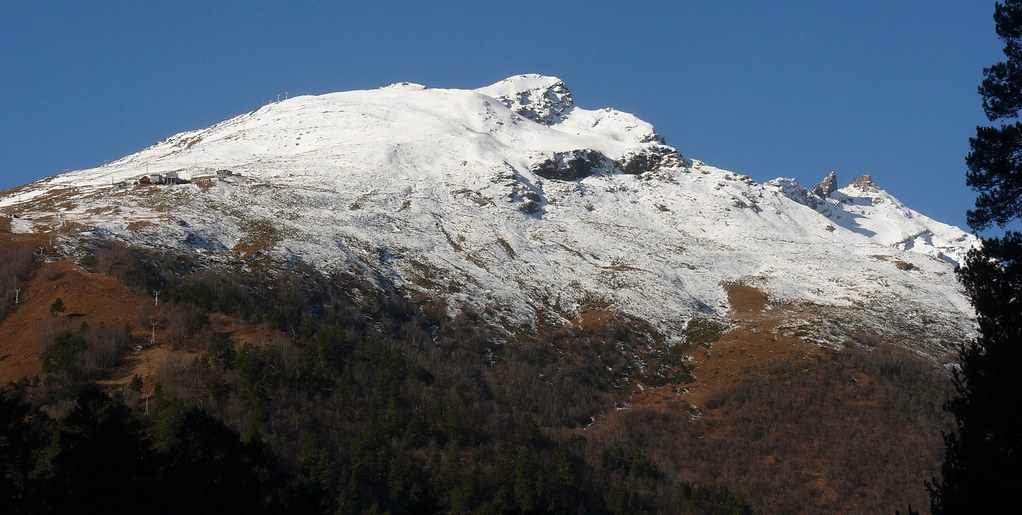
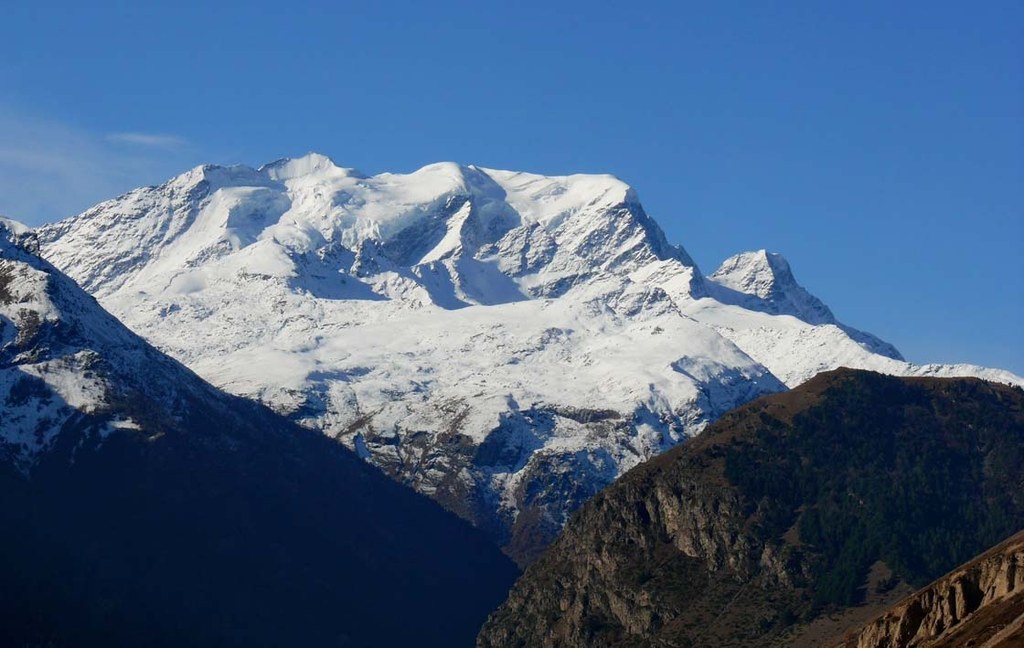
Word from Elbrus: Summits, Skiing, and Skydives (Explorersweb)
Elbrus.
Explorersweb about Elbrus. A plane jack last year involving climbers, a bomb destroying a Gondola lift and three skiers shot dead - Mount Elbrus was recently reportedly closed. Word arrived from Malli Mastan Babu (featured in Exweb for ...
Explorersweb about Elbrus. A plane jack last year involving climbers, a bomb destroying a Gondola lift and three skiers shot dead - Mount Elbrus was recently reportedly closed.
Word arrived from Malli Mastan Babu (featured in Exweb for achieving Fastest 7 summits in 2006) this weekend though that people are in fact climbing and skiing Elbrus. "Myself and another friend of mine from US (Nancy Bentley) reached the summit of Elbrus on Feb 25th," Malli wrote.
And this morning, another mail stated that UK Nigel Gifford OBE, "the grand master of adventure" is preparing for yet another world- first skydive this summer, this time over Mt Elbrus.
The Elbrus Skydive is taking place between the 20th-30th July 2011 and Nigel is looking for participants to join him.
"At age 65, Nigel is living proof that you are never too old to explore the dangerous and the unfamiliar," states the press release. "After the legendary Everest and Eiger skydives, Nigel’s Mount Elbrus parachuting quest follows another world first: his successful skydive in front of Mount Everest in 2008. And Nigel knows Elbrus well; the veteran mountaineer climbed the North Face of the Mountain last July with Dave Padgen, a two time Para Olympian who suffers from Cerebral Palsy. With a lifelong passion for life at its limits, Nigel is committed to planning and delivering unique, world-class adventures for his clients."
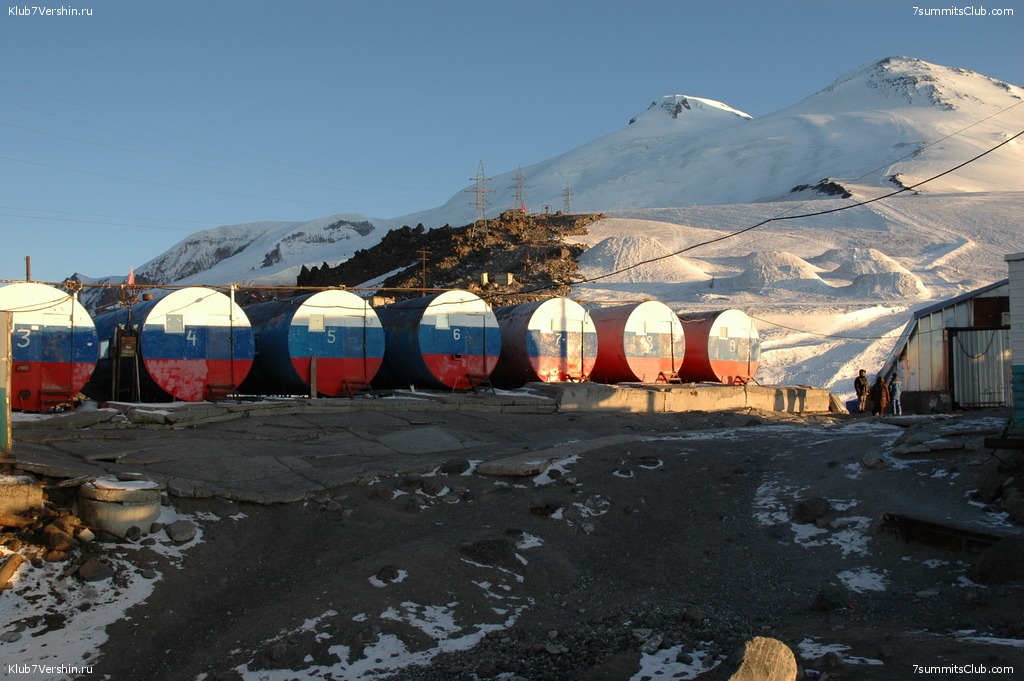
Seven summits of Steve Giesecke
Vinson.
There are few things on earth as rare as a truly perfect silence. Steve Giesecke would know. Having summitted the highest peak on each of the world's seven continents - each on the first attempt - Giesecke has been everywhere from the ...
There are few things on earth as rare as a truly perfect silence. Steve Giesecke would know.
Having summitted the highest peak on each of the world's seven continents - each on the first attempt - Giesecke has been everywhere from the equatorial jungles of Indonesia, and most recently, to the ice sheets of Antarctica.
The retired Air Force colonel returned from his final climb there only a few weeks ago. It was at Mount Vinson, on the world's most remote continent, where he experienced the most enveloping stillness he's ever known.
"When there's no wind - often there's wind - but when there's no wind, it's the quietest place on Earth," Giesecke said.
He found himself on a continent without a shred of development - no roads, cars, or people outside his group. The ice and snow absorbed any ambient noise around them. Even the voice of the nearest person couldn't travel far.
"You can hear your eyes blink," he said.
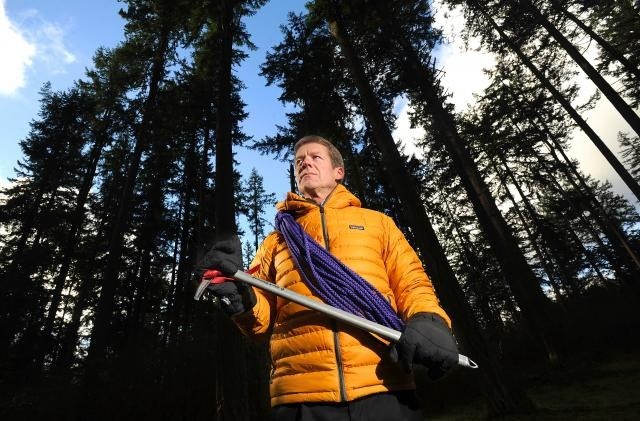
Like a lot of contractors at Joint Base Lewis-McChord, Giesecke spends most of his days at a desk. He works for the National Center for Telehealth and Technology, a Department of Defense office working to meet the psychological health and traumatic brain injury needs of the military community by developing and implementing technology solutions.
"I'm working on one of our initiatives that will bring the mental health programs of the DoD and VA closer together through collaboration on new technology assessment and development, in the areas of Web-based resources, social media and mobile applications," Giesecke said.
But in spite of the hours he spends in front of a computer, Giesecke's passion is pushing himself to the limit in some of the world's most inspiring locations. The result is a spectacular list of experiences - and more than a few examples of sheer determination.
Giesecke grew up in the Northwest, where hiking in the region's mountain ranges was almost a given. After college he climbed the Jungfrau in the Swiss Alps, which sparked an interest in climbing. When he joined the Air Force, he made a point of climbing mountains in the western U.S. between assignments.
Then in 1989, while stationed in Alaska, he climbed Denali, also known as Mount McKinley.
At 20,320 feet tall, Denali is the highest peak in North America and experiences some of the most severe weather in the world. In 1989 only 51 percent of climbers summitted the mountain, according to the National Parks Service. Today that number is 55 percent.
Giesecke had what he called "the usual experiences" on Denali. The weather was bad and only three of the people in his party made it to the top. At one point another group's tent was blown loose from the ridge above. Only one of the climbers made it out in time.
"It was very difficult back then," Giesecke said. "It still is very difficult, but back then things were a little bit heavier. You needed to take more time on the mountain to move the heavier equipment up."
About the same time, he read the book "Seven Summits" by Dick Bass, Frank Wells and Rick Ridgeway. Though at the time Giesecke thought the task out of reach for himself, the story of Bass and Wells, the first two men to successfully summit all seven peaks, would stick with him for years.
SETTING THE GOAL
When he retired from the Air Force a decade ago, Giesecke moved back to the Pacific Northwest, joined The Mountaineers club and started taking climbing classes. He continued climbing in the area, including summitting Mount Rainier multiple times. But Giesecke wanted a challenge that was bigger than he was. He wanted to know exactly how far he could go.
"I was in peak condition. I knew that if I was ever even going to have a shot at climbing the seven summits, any more of the seven summits, I knew it was then," Giesecke said.
In 2007 he signed up for a trip to Aconcagua on the Argentinean-Chilean border. The 22,841-foot peak is the highest outside of Asia. Giesecke told himself that if he made it to the top without any significant problems he would go straight to Nepal to climb Mount Everest. And in March of 2007 - after a U.S. pit stop just long enough to renew his passport - that's exactly what he did.
According to friend and fellow climber Gary Talcott, who grew up with Giesecke in Olympia, this level of resolve isn't out of the norm.
"He is very ambitious, goal oriented and determined to summit," Talcott said via e-mail, recalling a time when Giesecke helped him lead a group of climbers down from Mount Hood in whiteout conditions.
"It's fun to hear about his latest plans or last adventure," Talcott said. "I can just see the wheels turning."
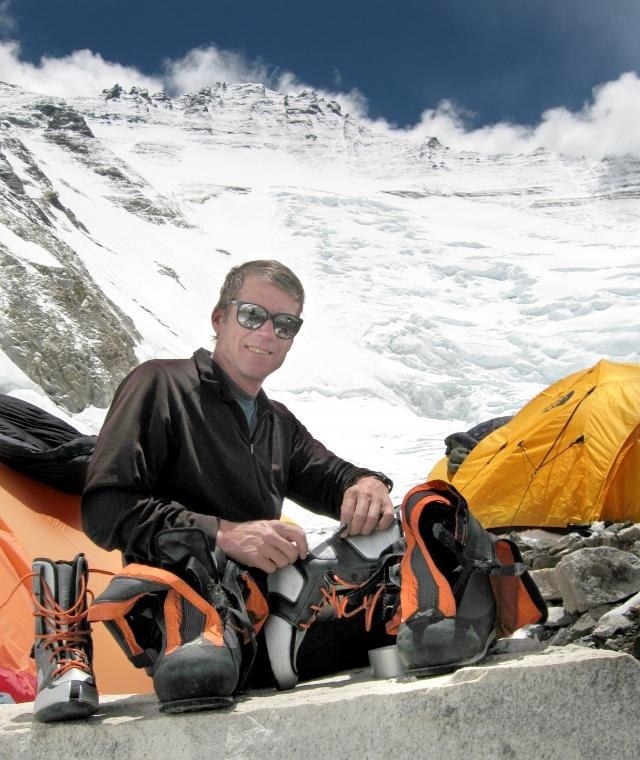
The Everest trip took him two months.
Mount Everest is the tallest mountain above sea level in the world. A 1999 survey sponsored by the National Geographic Society puts the mountain at 29,035 feet tall, so high that its peak reaches into the lower limits of the jet stream. Sustained winds at the top can exceed 100 miles per hour. In July, the warmest month on the mountain, the average daytime temperature at the summit is -2 F. In January, the coldest month, the average is -33 F but can drop as low as -76 F.
Conditions are, in a word, extreme. Giesecke's experience was nothing less.
Among the final hurdles before reaching Everest's summit is the Cornice Traverse, a 400-foot knife-edged ridge leading to the Hillary Step. Teetering too far to the left would send a climber down 8,000 feet along the Southwest Face. A misstep to the right would result in plummeting 10,000 feet down the Kangshung Face.
It was here that the snow beneath Giesecke broke through, sending him sliding downward.
"I only fell about 20 feet, but the air beneath my boots was endless," he said.
Fortunately the anchors held, and he continued toward the top. After tackling the final obstacle, the 40-foot climb up the Hillary Step, Giesecke summited the mountain.
"I went up Everest on May 20, 2007, and that was a fantastic day," he said, "to be on top of the world."
DOWNHILL FROM EVEREST
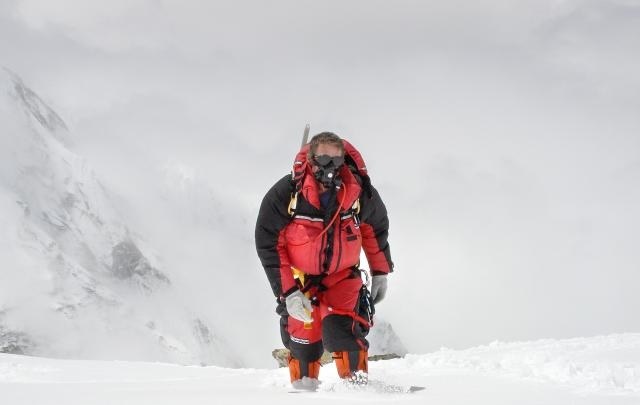
The following year he took on Mount Elbrus (18,510 feet tall) on the border between Russia and Georgia. After that he went straight to Mount Kilimanjaro (19,340 feet tall) in Tanzania, leaving the area only two days before Russia's invasion of Georgia in the summer of 2008.
His next challenge was Carstensz Pyramid in Indonesia. Because the highest point on the continent of Australia is little more than a hike, some climbers take on the 16,500-foot peak to check Oceania off their lists.
While the climb itself includes a 2,000 foot wall climb topped by a Tyrolean traverse-a gap of air climbers cross on a rope suspended between two high points-getting there is a challenge all its own. Even reaching base camp requires a two-week trek through the jungle, days away from civilization.
According to Giesecke, it's the toughest trail he's ever been on.
"The face climb itself was actually fun," he said. "The jungle approach was a once in a lifetime thing. I wouldn't do that again."
And so, there was only one left. Mount Vinson, Antarctica's tallest peak, stands at 16,050 feet tall. But to get to it, Giesecke would have to wait.
In January he traveled to Punta Arenas, Chile. From there he planned to fly to Antarctica - but things were not as simple as he had hoped. A strike over rising fuel prices shut down the area, leaving Giesecke cut off from the last of the seven summits.
"It's challenging to accept things beyond my control," he said.
For him, waiting is the hardest part about mountain climbing - knowing that the goal is out there ahead of you, but not being able to reach out and grab it.
Giesecke was stranded in Patagonia for two weeks waiting for the strike to end. Not everyone in the group was as patient or invested. Some went home before so much as setting foot on Antarctica.
Not Giesecke.
"I'd gone all the way down to the end of South America to complete this trip," he said. "That's what I intended to do and that's what I did."
On Jan. 27, he made it to the top, finishing a journey he started in 1989.
"It's still sinking in," Giesecke said. "When I finished I came back home and I got out the book 'Seven Summits' and looked at it again."
Like explorers before him, Giesecke has been asked time and again why he does it. And really, there are countless reasons - the camaraderie of accomplishing great things with other people, the physical challenge, George Mallory's classic "Because it's there."
But for Giesecke, perhaps what it really comes down to the liberating challenge.
"I think when you're climbing it's one of the ultimate expressions of freedom," he said.
There aren't many places left with so few restraints, he said. But when he's pushing himself toward the summit of some impossibly high mountain, the only thing holding him back is how high he can climb.
By Marisa Petrich (Northwest Guardian)

Elbrus as a second national project or Caucasus ski resorts behind a fence
Elbrus.
Despite recent terrorist attacks near Elbrus Mountain in the North Caucasus, plans to establish a tourist industry in the region remain intact, even though tourists are currently banned from the region during a counter-terrorist operation. ...
Despite recent terrorist attacks near Elbrus Mountain in the North Caucasus, plans to establish a tourist industry in the region remain intact, even though tourists are currently banned from the region during a counter-terrorist operation.
Tourist cluster
A special law providing tax breaks for the tourist cluster in North Caucasus has been discussed at a meeting with President Dmitry Medvedev’s aide Akrady Dvorkovich, Vedomosti reported. The law could be accepted before the end of the year.
Five zones in the region are part of a single tourist cluster Vysota 5642 (height) in Karachayevo-Cherkessiya, Kabardino-Balkariya, North Ossetia, Dagestan, Krasnoyarsk region and Adygea. The resorts, aimed at bringing in income and jobs to the ailing region, will have a total budget of 451.4 billion roubles, 86.7 per cent will be attracted through private investors.
The Skolkovo of the Caucasus
The resort organisation suggested removing all taxes apart from VAT for the participants of the scheme for ten years, as well as fast-tracking bureaucratic and land paperwork.
The company will have to follow up the proposal with finance ministry, but Dvorkovich assumes that there should be no problems for tax breaks similar to Skolkovo’s.
In the innovation centre investors are exempt from profit and property tax, and insurance is at 14 per cent. The resorts will receive the land for free, and will then have the right to rent it out to investors for 49 years.
Terrorists fenced off
With security as the main concern in a region often hit by terrorist attacks, the tourist cluster recognise that it is an issue they will have to address.
There were also calls to build a three metres fence around the resorts to ensure the guests’ safety in the volatile region.
However, that suggestion was deemed excessive, and law enforcement were tasked with developing constructive safety measures in the cluster and the region overall.
Sources in president’s administration say there may be a clause about safety issues in the region in the law.
Cameras to protect from attacks
The fence will also ruin the face of the resort and it could be climbed over, president of Gorimpeks group and co-owner of Krasny Shtorm security holding Viktor Volikov told Vedomosti.
In order to fight terrorist attacks Volikov suggest surveillance. It would be much more effective to have surveillance stations along the tramway that would monitor data from video cameras set up on every support.
However, safety issues for locals have to be solved before any tourists should be allowed to go there, according to head of Public chamber expert group on North Caucasus Kaloi Akhilgov.
And for this law enforcement has to work better to understand the reasons for the sudden surge of violence in Kabardino-Balkaria, where it has been relatively quiet for many years.
Richard Parks ready to take on the world
South Pole.
In the third of his BBC columns, Richard talks about his final preparations for his '737 Challenge' during which he aims to climb the highest mountain on each continent, plus reaching both the South Pole and the North Pole for charity - all ...
In the third of his BBC columns, Richard talks about his final preparations for his '737 Challenge' during which he aims to climb the highest mountain on each continent, plus reaching both the South Pole and the North Pole for charity - all within seven months in a bid to raise £1m.
The clock is now ticking towards 12 December when I fly to South America and then Antarctica on the way to the start of this most gruelling of challenges.
It's just mind-blowing to think how quickly the challenge has come round from conceiving it 15 months ago. I'm both scared and excited, but just want the whole thing to start.
I've done all the training now and I don't think I can do any more. I feel physically and mentally prepared for the challenge, which if successful will see me become the first person to stand on the continental summits and the poles in the same calendar year.
The challenge consists of the South Pole, Mount Vinson (4,897m), Aconcagia (6,962m), Mount Kilimanjaro (5895m), Carstensz Pyramid (4,884m), the North Pole, Mount Everest (8,850m), Mount Denali (6,194m) and Mount Elbrus (5,642m).
If all goes to plan I'll be at the South Pole on 1 January and finish up at the top of Mount Elbrus on 31 July.
Over the last few months, and especially my final training on Cho Oyu in the Himalayas, I have developed this toolbox of mountaineering skills that will give me the best chance of success. But ultimately we are in the hands of mother nature and she could put a spanner in the works!
Since coming back from the Himalayas in October there has been no let up in attempting to boost my aerobic capacity. I competed in the Cardiff half marathon and then took part in the Cardiff Burn - a 10k run, a 42k bike and a 3k kayak. That was hard, but great preparation.
Everest would seem to be the biggest challenge but we have highlighted Denali as the toughest leg because in it's a brutal mountain in its own right
But I did have a setback when I lost my training partner on a run on the Ogmore coastal trail. Unfortunately my dog Ben fell down a hole and broke his leg. He's feeling a bit sorry for himself but he'll be okay.
The last couple of weeks I have been trying to taper down the training and have given Kevin Morgan, the former Wales international full-back who is helping me train, something of a poser.
I told him I want to be fit and fat before I go! I want to maintain my fitness but also to go into the challenge carrying a bit of extra weight with a big intake of carbohydrates.
A lot of my energies have been put in to the packing and sorting my gear out. I have to pack bags now that will be air freighted on to Everest base camp. Packing for nine legs over seven months is pretty challenging to say the least.
And on the other hand is the charity. I recently visited the cancer day care centre which was a real humbling experience and gave me some real inspiration for my trip.
I have spent every penny I have and every waking hour of the last 15 months on this unique challenge because I am very serious about it and its integrity. I was very down after my rugby career was ended with a shoulder injury and this has given me something to focus on.
At half-time during the Wales v New Zealand international at the Millennium Stadium I was presented with a special badge by Carwyn Jones, Wales' first minister, and WRU chief Roger Lewis. To get the ovation I did from the 70,000-odd fans in the stadium was a real lift.
After leaving on 12 December I don't get much thinking time because I'll be in Antarctica on 14 or 15 December and straight into the challenge. The plan is we get to the South Pole on 28 December.
And that poses a problem because I will have to wait there until 1 January so it qualifies with the calendar year requirements of the challenge. That has been one of the logistical hurdles I've had to overcome and I will have to get a flight back on my own on a supply plane.
Then it's back to Mount Vinson on Antarctica and then on to Aconcagia in South America - the highest mountain outside the Himalayas.
The crux of the challenge is further down the line - the North Pole, followed by Mount Everest and then on to Mount Denali. The North Pole presents the highest risk of cold or frost injury, and every day we are battling the north pole we are missing a day acclimatising on Everest.
Everest would seem to be the biggest challenge but we have highlighted Denali as the toughest leg because in it's a brutal mountain in its own right. Extreme weather systems and I will be doing it at my weakest mentally and physically because I will be coming straight off Everest.
We are aiming to be on Everest in April and May. Statistically the highest summit success rate is early May and after that we are looking at four to six days to climb Denali.
The aim then is to reach the summit of Mount Elbris before 31 July.
Richard Parks was speaking to BBC Sport Wales' Richard Thomas
Source:
http://news.bbc.co.uk/sport2/hi/rugby_union/welsh/9239634.stm

Round table "Russian Mountain Guides – formation of professional community" ...
Everest.
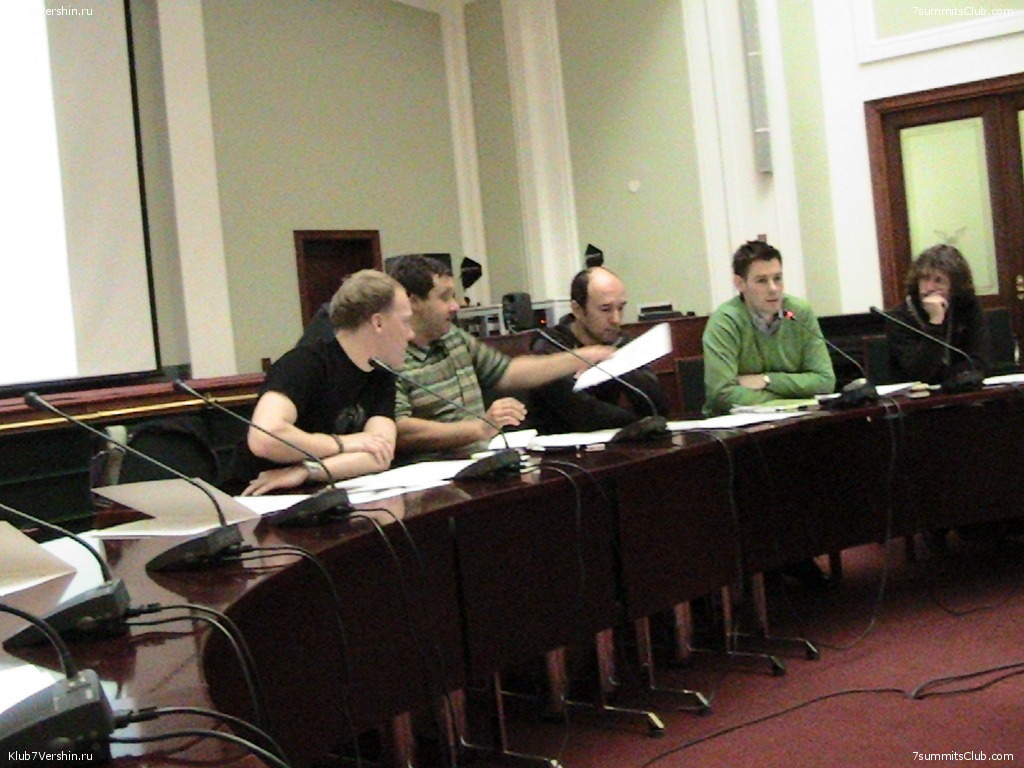
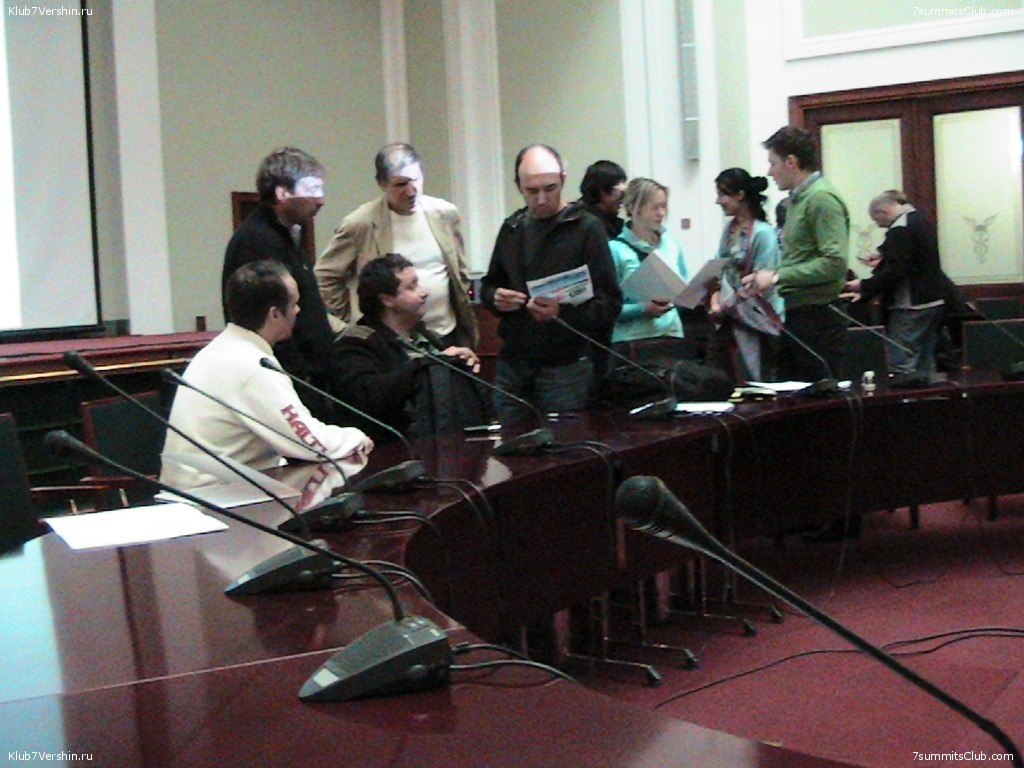
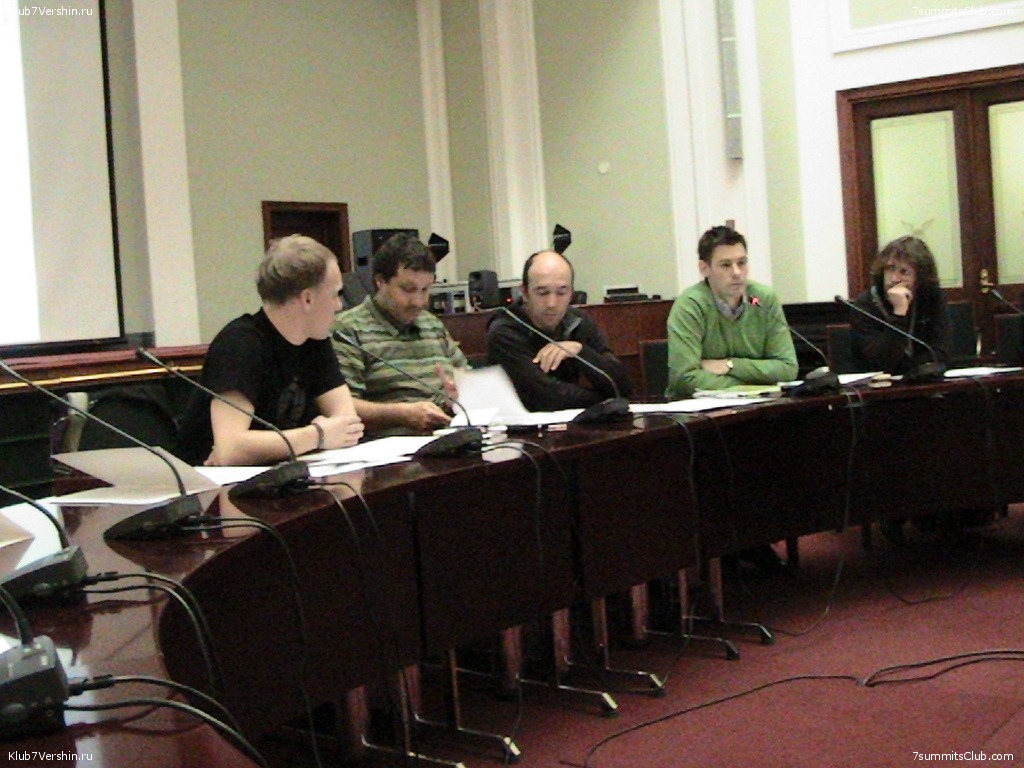
"Round Table. Russia mountain guides - becoming a professional community "was held on 29 October as part of the exhibition "International Ski Salon”. It was an informal meeting of members of the Association of Mountain Guides of ...
 "Round Table. Russia mountain guides - becoming a professional community "was held on 29 October as part of the exhibition "International Ski Salon”. It was an informal meeting of members of the Association of Mountain Guides of Russia, a report of committee and discussions of some details of its work. one of the chairmen of the organizing committee of the Association of Mountain Guides of Russia Sergei Zon-Zam introduced Russia Officer Russian Mountaineering Federation (RMF) Roman Bryk for a report.
Post Roman was quite brief. The Work is proceeding and is now in the stage of signing contracts with partner organizations. The choice is approved in favor of "Canadian" model, with separation of the ski and climbing blocks. Fedor Farberov is working on programming. Partners RMF for the School of guides to determine for 2011. In the near future site of the Association of guides should start working.
Maxim Balakhovsky made on submission of the draft Etique Code was made by a mountain guide. Actually, he just read it with little commentary. In developing the basis for the Code is taken code UIAGM. This part of the Round Table program caused the most lively discussion ..
The second chairman Nicholay Veselovsky, Director of "Vertical World Co made an announcement for 2011: Schematic diagram of the Russian national school of mountain guides, modules for 2011 and school partners. Next year, two units of the School will be held in June and one general unit will be held in December.
Partners: Gore-Tex, Red Fox, Pieps, Petzl,
Leading the seminar stressed that for the first issue of school guides, they are going to possibility to take part for future teachers of the school guides. The process of recognizing the future diploma by UIAGM structures will be very long and we have to start it, even if not completely ready.


Ossetian authorities decided to erect on the route to Kazbek three mountain huts
Elbrus.
Now a new state tourism development program in the North Caucasus aimed at construction of Olympic facilities in Krasnaya Polyana. However, all republics of this region have their own plans for development of mountain infrastructure. So in ...
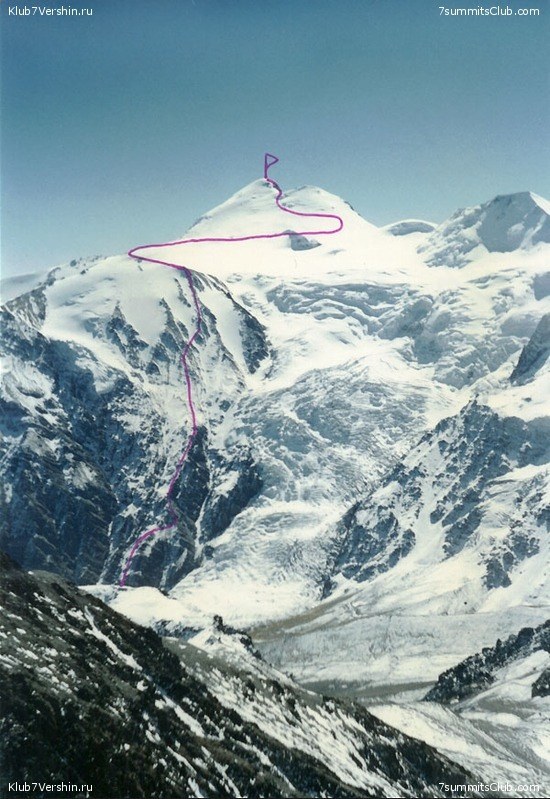
Now a new state tourism development program in the North Caucasus aimed at construction of Olympic facilities in Krasnaya Polyana. However, all republics of this region have their own plans for development of mountain infrastructure. So in North Ossetia, a work on construction of a large resort in the area Mamison pass already began. In addition, the river valley Genaldon is the focus of the authorities, through which the route goes to one of the most famous mountains of the Caucasus – Kazbek (5033m). In this year's there was a regular annual International alpiniada from 4 to 13 September. About 200 people from Russia and CIS countries have climbed to the top of Kazbek. But now the route is still without a single mountain huts, all nights are in tents.
 Chairman of the Republican Committee on Tourism, Oleg Karsanov stated that the Committee has developed a plan to build on the route to the summit of Kazbek on the northwestern slope of the glacier Mayli three mountain huts: at elevations 2,300 m, 3450 m, 4149 m.
The highway to the village Tmenikau will be reconstructed and extended further up to the level of 1950 m (sandy river of Genaldon). Wide footpath will be laid to the upper hot Karmadon springs (2300m), where it will be built a largest hut. In this area there are great opportunities for trekking and easy climbing. Except in the Kazbek district has a number of beautiful mountains: Dzhimarai-Hoch, Miley-Hoch, Shaukudza, Dzarasova Peak (Peak Polyakov), Pastukhova Peak, Peak Surveyor.
A traditional route to Kazbek from Russian (Ossetian) side
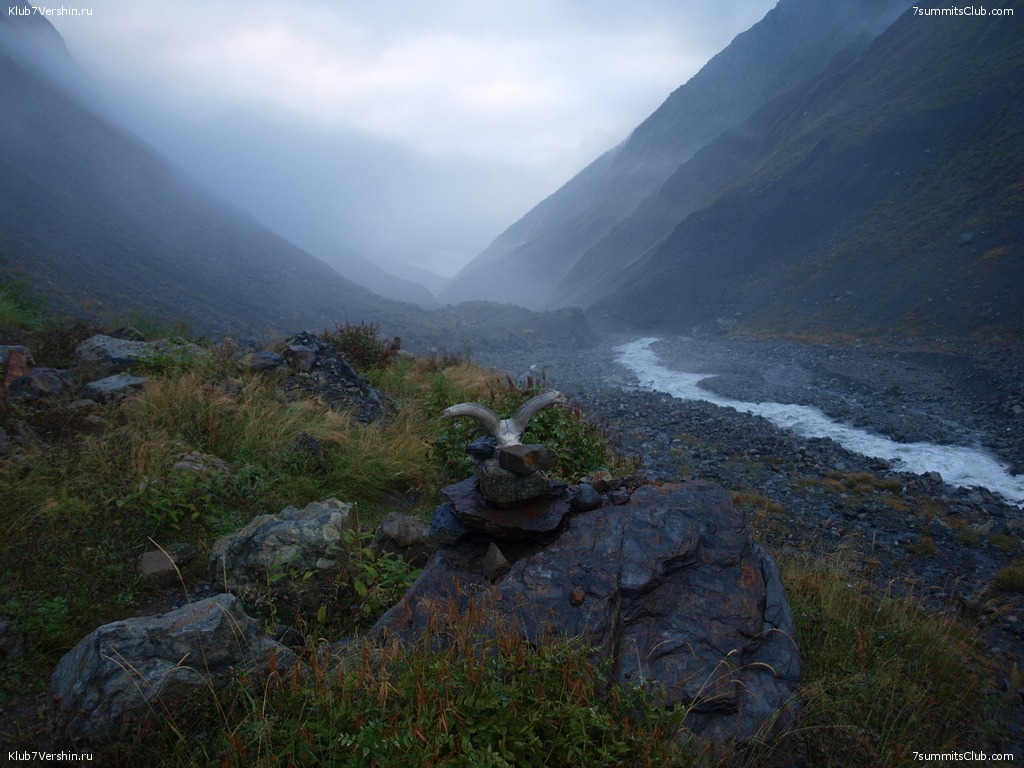
Genaldon Valley
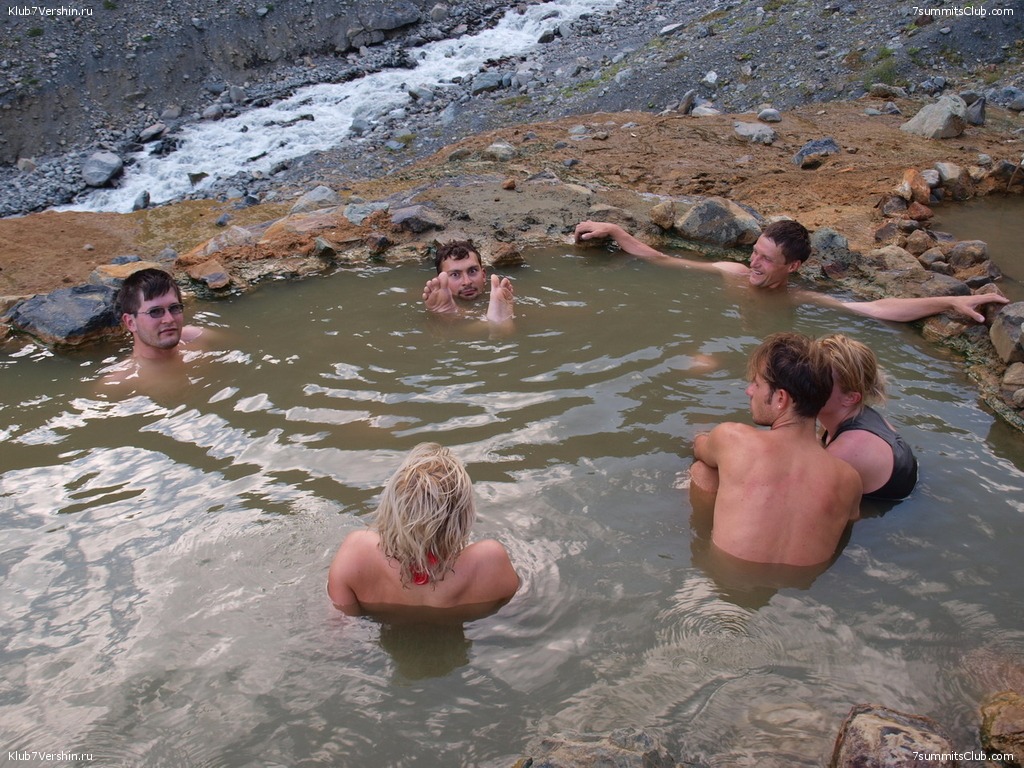
Karmadon hot springs
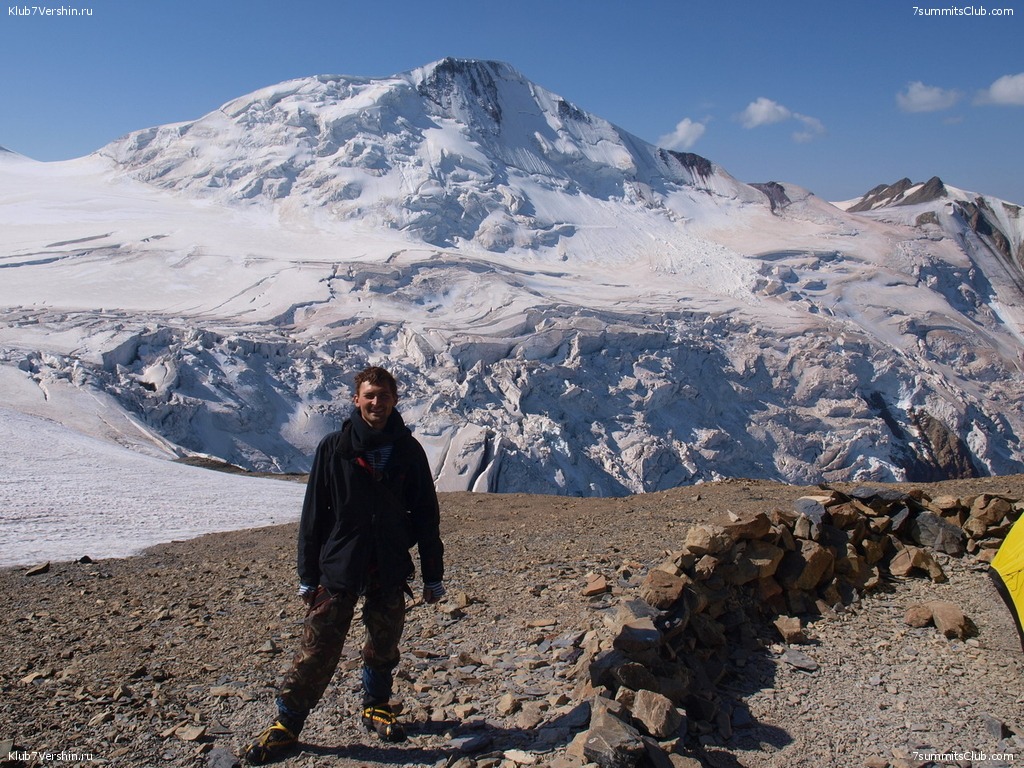
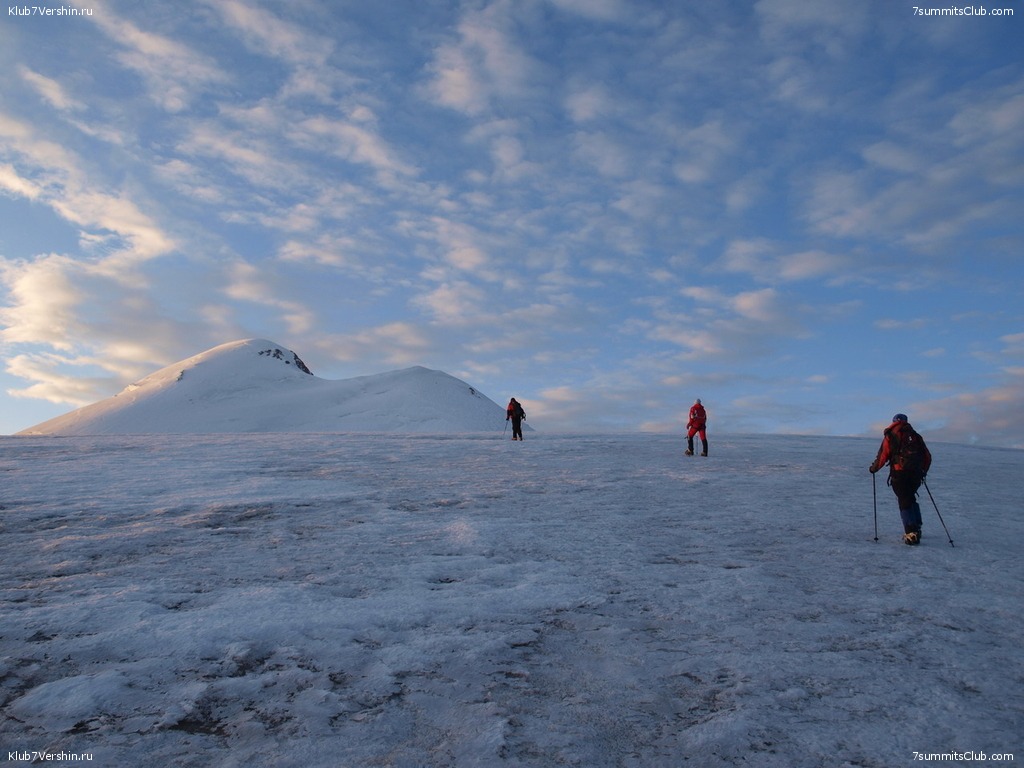
To the summit of Kazbek
What happened to the hut on the saddle of Elbrus?
Elbrus.
Construction of rescue hut on the saddle of Elbrus carried out almost three years. Mountaineering Federation of Russia supported an initiative of some climbers, there were found money and volunteers for the work. Grand opening of the hut ...
Construction of rescue hut on the saddle of Elbrus carried out almost three years. Mountaineering Federation of Russia supported an initiative of some climbers, there were found money and volunteers for the work. Grand opening of the hut was on Sept. 1 2010, at an altitude of 5,300 meters. In September, Alexander Abramov, lead a group climbing Elbrus, had organized rescue work for a Polish climber. Hard to say, could this be done without the hut.
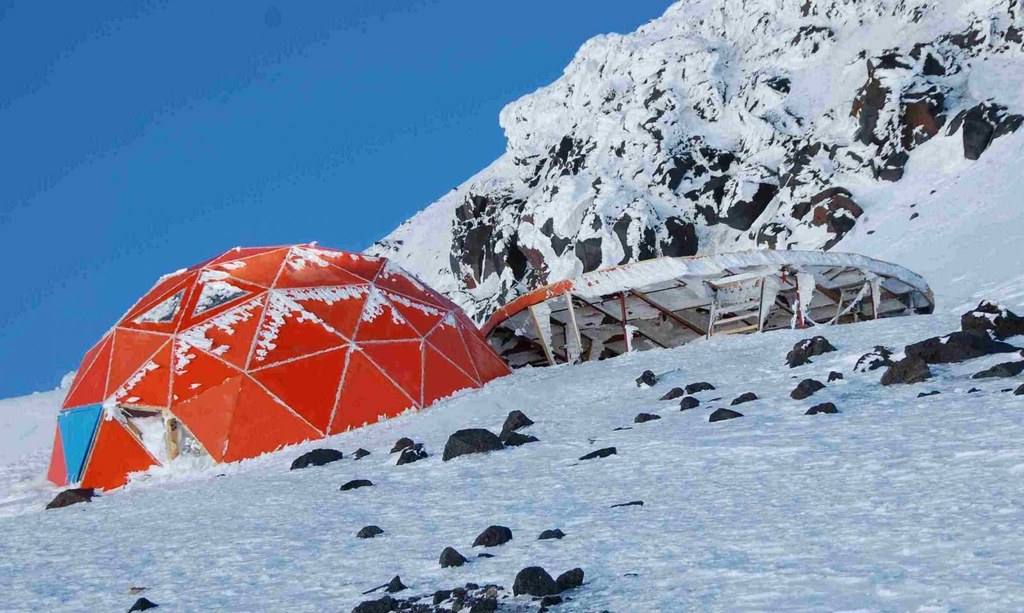
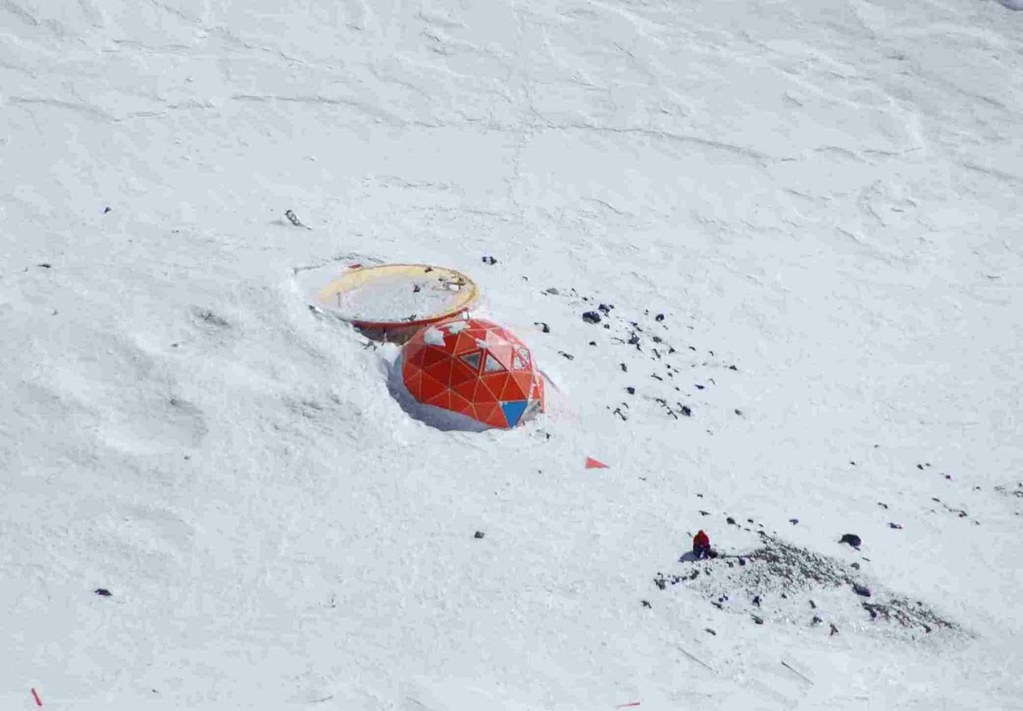
However, in late October, guide Eugene Kruten, climbing on Mount Elbrus, found that the refuge is destroyed. Upper part of hut is separated from the base and lying quite near but aside. This fact has caused surprise and intense discussion of what happened. In principle, the general conclusion is: it must be restored. Reason of destroying: changes in design, connected with the loss of some details during winter storage. Wind on the saddle has hurricane strength, quite often. We need more precise engineering calculation.
Two photos from Eugene Kruten
Rescue work at the hut

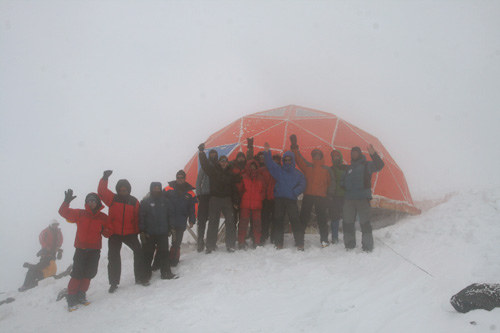
1th September, opening

Second from Seven for Nepal Women Team
Elbrus.
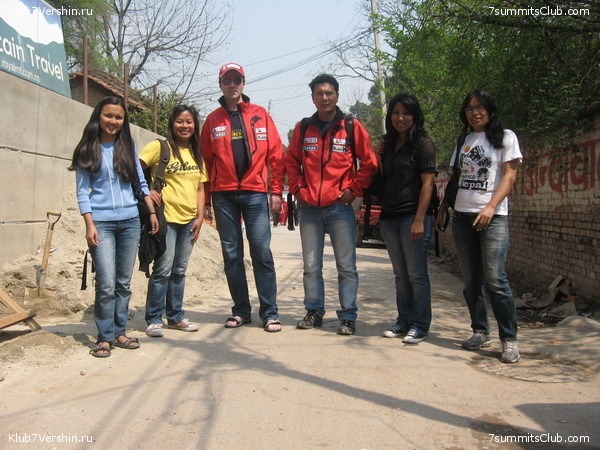
We are waiting for them in Elbrus. Report: “ Our team climbed Mt Kosciuszko/Targangil on 7th July. It was a beautiful clear day. It was incredible experience to climb one of the world’s oldest mountains. Like they say in ...
We are waiting for them in Elbrus. Report: “ Our team climbed Mt Kosciuszko/Targangil on 7th July. It was a beautiful clear day. It was incredible experience to climb one of the world’s oldest mountains. Like they say in Australia, it may not be the tallest mountain in the world but it certainly makes you feel like on top of the world.
Outdoor Education Group from Moss Vale and Wilderness Sports made all the arrangements for the climb. Kosciuszko National Park helped with much information on the impact of climate change on the Snowy Montains. Ranger Rob Gibbs and Apline Scientist Ken Green accompanied the team on the summit along with friends from The Crossing Land Education Trust, Veg Climate Alliance and media.
We learnt from Ken that Australia has lost 30% of its snow in last 50 years. Mountain Pygmy Possum and alpine vegetation that used to get thick snow cover to hibernate underneath are now exposed to frost as there is not enough snow. As a result, certain species are threathened as cold is killing them”
Site: http://sevensummitswomen.org/

--
The team
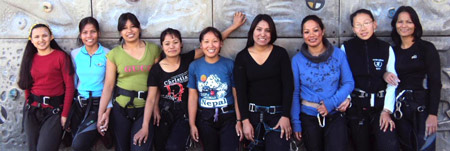
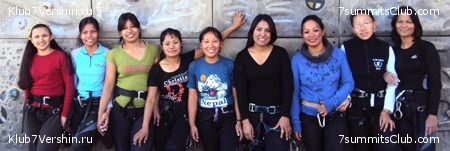
The team members came together in 2007 to climb Mt Everest in 2008 spring. The expedition was called ‘First Inclusive Women Sagarmatha Expedition 2008 Spring’ (FIWSE).
Fastest climber to summit Everest Mr Pemba Dorje Sherpa brought forward the idea of organizing a Nepali women’s Everest expedition in order to increase their participation in mountaineering. Only seven Nepali women had reached the top of the world till 2007.
Mr DaGombu Sherpa and Ms Susmita Maskey joined the organizing committee. Nine women, who are now on a mission to climb the 7 summits, joined the team as climbing members.
FIWSE faced several challenges. It was not easy for the team to raise an enormous budget required for the expedition. Thanks to Nepal Government, United Nations World Food Programme, BP Koirala India-Nepal Foundation, United Nations Development Programme, MTV Exit, Swiss Agency for Development and Cooperation and many of our supporters, FIWSE was able to create history.
All women in the team made it to the summit and by May 25th, 2008, FIWSE became the most successful and largest women expedition to climb Everest. Also, first Nepali women from Brahmin, Gurung, Danwar and Chettri communities reached the top of the world.
The climbing members started a non-profit, non-government organization Global Inclusive Adventure Organiation (GIA) after the expedition. GIA focuses on environmental, empowerment and educational aspects of tourism sector.
The team traveled across sixteen districts of Nepal visiting schools and motivating students to climb their own mountains in a program called ‘Inclusive Sagarmatha Speakers’ , supported by United Nations World Food Programme. After the expedition, it was during the school program the team witnessed instances of climate change in various parts of Nepal. This encouraged the team to carry with them a message for climate action.
Everest Women 7 Summits Eco-Action, GIA’s brainchild was thus born.
Shailee Basnet (Coordinator) - A graduate of Business Information Systems and a Post Graduate of Journalism, she works as a reporter for Himalmedia. She became interested in climbing and mountaineering because of the physical and mental challenges it poses, which are quite different from her line of work. Lack of involvement in any kind of sports during her early years made her interested in challenging her limits as she grew up. At 25 years of age she reached a new height on May 24th 2008 by standing on top of Everest.
Asha Kumari Singh - A 24-year-old student, Asha comes from Danuwar community from Meghrail, Mahottari. She comes from a society where women are barely aware of their rights, are supposed to get married off sooner than later and dowry is rampant. Thanks to her grandmother who thought Asha was the ugliest girl among all five sisters and hence thought it was necessary to educate her, in case nobody wanted her marry her. Asha however was not worried about her looks but coming from the flatlands of Terai, was always curious about high mountains. She came to Kathmandu for higher education and got an opportunity to join the Female Outdoor Leadership training in the Annapurnas in the year 2004. Given her background she challenged conventions and impressed naysayers when she started climbing. She made not only her community but also the entire nation proud as she stood on top of Everest on 24th of May 2008.
Chunu Shrestha - Hailing from a poor Kathmandu family, Chunu began working to help support her family while she was just a sixth grader. Despite the financial hardships, she finished high school and started pursuing her education in Bachelors of Arts. When she heard about Susmita Maskey’s summit attempt in 2005, she became inspired by the possibility of succeeding in adventure tourism to support her family. With FIWSE she was able to nurture her passion for the outdoors that she dreamt about during her long days of work. At 27 years of age, she reached the Everest summit on the 25th of May 2008.
Nimdoma Sherpa - Still in high school, Nim is the youngest woman to climb Everest. Despite her small stature, she is dauntless and a very good climber, who impressed everyone during the Basic Mountaineering Course. She had her own struggle on the personal front. Her father passed away while she was a tenth grader. Still she continued her education, subsequently becoming the first in her family to complete the School Leaving Certificate (SLC). She spent lonely childhood in Kathmandu away from her mother for education. She took care of household chores while other children played. But she knew her life was destined to be different than that of everyone else around her. When she learnt about First Inclusive Women Sagarmatha Expedition she knew this is what she was waiting for. At 17 years, she set foot on the top of the world on the 22nd of May 2008. She is ruling wall climbing national champion.
Pema Diki Sherpa - Pema Diki, 22, is one of the three girls born to a struggling couple who moved to Kathmandu from Dolakha with nothing but the clothes on their backs. Two years before joining the expedition, a chance to trek in Gosainkunda enchanted this acupuncture assistant. Basic Mountaineering Course presented her more challenges which left her with desire for more climbing experience. She achieved what she had long dreamt for on 24th of May 2008 when she bowed her head to Cholmolungma, the mother goddess of the world. She has great faith in education and as a child dreamt of being a teacher. The team has been conducting educational interaction in different parts of the country, sharing the experience of struggles and lessons learnt during the expedition, motivating students to believe in their dreams. With this program her childhood dream became reality. She aspires to travel and learn more in life and share her knowledge and experiences with youth all over the world.
Pujan Acharya - Pujan worked as a human rights activist in Dolakha. From early on, despite growing in a society where women are supposed to stick to household chores, she had a passion for sports. In her village, she used to play with men for there wouldn’t be women players. An accomplished volleyball player and marathon runner, Pujan, 25, holds several awards for competition at the district Level. But that was not enough for someone who grew up at the foot of Rolwaling Himalayas. She gained her first mountaineering experience in 2003 when she completed Female Outdoor Leadership training. Finally she made it to the summit of Mt. Everest on 22nd of May 2008. She enjoyed a different taste of Everest and adventure as she skydived in the Everest region on 17th October, 2009 from 29,300 ft. During the cabinet meeting of Nepal Government held at Kalapatthar (5240 m), she actively participated as a venue manager.
Maya Gurung - Maya had a childhood marred with struggle and was an early rebel. She saw poor state of women both in her home and village. She always wanted to break free from it. Maya tried hands on various fields including bowling where she reigned as national champion for four years. But nothing really satisfied Maya before she went ahead to join Basic Mountaineering Course and then to climb Everest. This rebel at heart finally lived her dream of climbing on top of the world on 22nd of May 2008, and became the first Gurung woman summiteer at the age of 28. She lived her long cherished dream of sky diving on 10th October, 2008 with Everest in the backdrop. Maya led the Mt Manaslu clean-up expedition as coordinator and also was active venue manager for the cabinet meeting of Nepal Government held at Kalapatthar (5240 m) on 4th December, 2009. Her dream is to see women empowered and educated so that they are at least able to stand up for themselves.
Ngabhang Phuti Sherpa - Ngawang is from Taplejung district, home of Kanchenjunga. She lost her parents in an early age. She and her elder sister quit education to take odd jobs to look after younger siblings. She ran a restaurant in Kathmandu for couple years and quit it later after her sister went abroad. Several Sherpa climbers encouraged her to explore mountaineering. But she did not like the idea of climbing alone. When she learnt that a women’s team was being put together for climbing Everest, her hidden desire made her give it a shot. This 33-year-old woman felt she did the right thing when she joined Basic Mountaineering Course. On the 22nd of May 2008, she reached her highest destination, Mount Everest.
Usha Bist - Born as fifth daughter in the Far-Western district of Kailali, Usha was left in the jungle for dead. That’s what earned her nickname Bandevi- goddess of the forest. It was a fellow villager who saved the new-born. From early on, Usha was inspired by women climbers and wanted to climb Mt Everest herself. She came to Kathmandu to climb Everest, not knowing where to start. She completed basic and advanced mountaineering courses, climbed a number of peaks including the notorious Amadablam. In 2007, she earned spot in the Loktantrik Expedition Team, to attempt Everest. She was left behind at 8,400m and later rescued. To everybody’s surprise, this 24 year old finally stepped on the top of the world a year later. Her connection to forest is still alive as she is the president of Sasakta Mahila Samudayik Ban in her home district.

Seven summits to fly from. Project of South African climbers
Elbrus.
A team of three intrepid athletes is preparing to climb the seven highest mountains on all seven continents, and then paraglide down, to raise funds for charity. THE paraglider slowly drifted down from the ...
A team of three intrepid athletes is preparing to climb the seven highest mountains on all seven continents, and then paraglide down, to raise funds for charity.
THE paraglider slowly drifted down from the blue sky, moving in broad circles as he lined up to land alongside a banner reading "Seven summits, 7 flights".
Pierre Carter paraglides in to the press briefing at Delta Park Pierre Carter's aim was perfect - he landed softy and gently ran up to the crowd gathered in Delta Park in northern Joburg, his rectangular orange and white parachute billowing behind him.
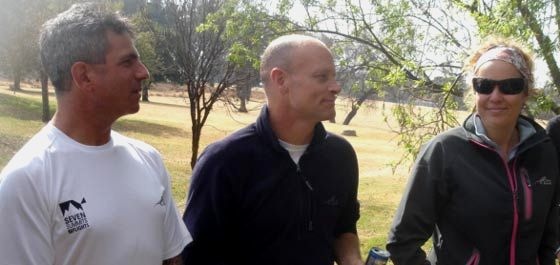
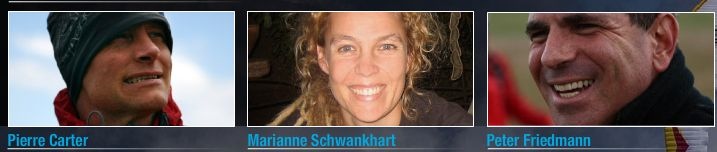
Carter is one of three athletes to tackle this "journey of a life time", in which they will be the first team in the world to summit the highest mountain on each of the seven continents, and once on the summits, paraglide down to their starting points. The other members of the team are 33-year-old Marianne Schwankhart and Peter Friedman. Carter and Friedman are both 43.
They will set off on Sunday, 11 July and begin by tackling Mount Elbrus in Russia, at 5 642 metres. The other summits on which they will be leaving their footprints are: Carstensz Pyramid in West Papua, Indonesia (4 884m), Mount Vinson in Antarctica (4 897m), Kilimanjaro in Tanzania (5 895m), Denali in Alaska (6 194m), Aconcagua in Argentina (6 959m), and the tallest of them all, Everest in Nepal (8 850m).
They admit that Carstensz Pyramid is the one that makes them the most nervous; despite the fact that it is the lowest, it is the most dangerous, and no one has ever tried to paraglide off it before.
"Walking back down a mountain is the most dangerous part of climbing, so paragliding down will reduce the risks," says Carter. All three members of the expedition recognise that there are great risks involved.
Problems for paragliders at these heights include strong winds and temperatures dropping to -30°C, or -50°C with the wind chill element. If the winds are too strong they will have to wait until they drop, for up to eight hours, if necessary.
The three have had special lightweight gliders made, weighing 10 kilograms. A standard glider weighs 40kgs.
Carter and Schwankhart will do a tandem paraglide off the summits, so that Schwankhart can photograph the summits on the way down, while Friedman will attempt the flights as a single glider. They will be taking along two cameramen, Guy Habbard and Kyle O'Donaghue, to capture the three of them climbing and flying. Both are climbers as well.
Everest
The idea originates with Carter, who has had this dream since 1991. The team expects to finish the challenge in around two years, largely driven by financial constraints and weather and seasons. For instance, Mount Everest can only be climbed between March and May.
The idea of climbing the seven summits originated with Dick Bass in 1985. Since then more than 200 people have climbed all seven. Climbing and paragliding off them has been attempted before, by a French couple, but they never completed the task.
Carter has been paragliding since 1988, and represented South Africa in the world paragliding championships for five consecutive years between 1991 and 1995. He has been climbing for almost 30 years and has summited and paraglided off two of the seven mountains - Elbrus and Aconcagua. He is considered to be one of the 15 greatest paragliders in the world, and will be the team leader of the expedition.
Mountaineer
Schwankhart, an award-winning photo journalist with The Times newspaper, has been a climber since 1995. She was the first woman to climb the sheer east face of the central tower of the Torres del Paine in Chile in 2003, and returned in 2008 and climbed all three of the peaks, again setting the record for a woman.
Paragliding off Mt Elbrus in Russia In 2005, she climbed the Trango Tower in Pakistan - 900m of vertical rock face - to a height of 6 500m. The same year she climbed Cerro Torre in Patagonia, Argentina. Climbing a sheer cliff face requires the climber to sleep for several nights on the mountain, sleeping in a suspended hammock-like contraption, hanging from the mountainside.
In 2006, she filmed No Need for Parking - an Africa Rock Adventure, a record of her climbs in southern Africa. Remarkably, Schwankhart doesn't see the climbing or the sub-zero temperatures as her greatest challenge in the venture; she wants to be able to take good photographs.
"The purpose of my trip is to take amazing photographs, so I hope I can do this. My main worry is whether my camera batteries are charged," she explains. The climbing is of secondary concern. "Mount Elbrus is an easy mountain, I am not too worried. I can rely on muscle memory for the climb."
She is not a paraglider though, and is a little concerned about being air sick.
Friedman has been paragliding for eight years and has fixed-wing and helicopter licences. He has a black belt in karate and has represented South Africa in Japan at the world karate championships. He has also represented South Africa in the world surf skiing championships in the United States.
He has been the driving force behind putting the expedition together, raising the all-important funding and sponsors.
Flight from Elbrus by Carter
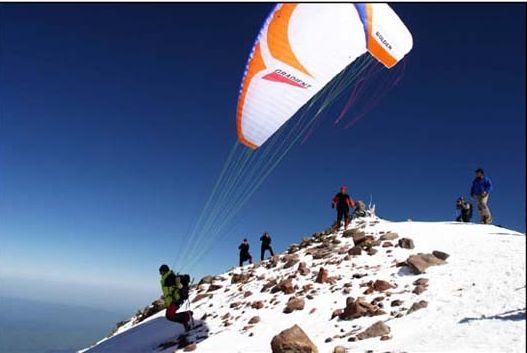
Funds
The expedition will be raising funds for The Trust, an organisation that raises funds for 100 charities, with causes ranging from crime survivors, abused animals, HIV and Aids sufferers, to protecting the environment. This year's particular cause is fighting human trafficking, in partnership with Cintron Africa, says Tracey-Lee Cohen, the managing trustee.
The Trust will run a series of TV and radio adverts by R&B singer Akon to assist in raising awareness of human trafficking. "The anti-human trafficking case is just one example of a social cause that will benefit from the bravery and initiative shown by the 7 Summits 7 Flights team," says Cohen.
The expedition will also be raising funds for The Smile Foundation, a charity involved in assisting children with facial anomalies get surgery.
"We admire the dedicated work of charitable organisations such as The Smile Foundation and hope to help provide them with the resources and funds they need to do their work and overcome their own challenges," says Carter.
The three estimate they will need about R7-million to complete the whole venture. All the gear has been sponsored, but funding is still needed. Donations can be made through their website.
The team can be followed on a range of social media: they will be updating their website, Twitter and Facebook pages every few days, and articles will appear in The Times newspaper. DSTV will provide R2-million in airtime to the expedition.
Read more: http://www.joburg.org.za/content/view/5430/266/#ixzz0tBukqMMj
*********************************************************************

THE MISSION
7 Summits 7 Flights is an initiative pioneered by Pierre Carter, Marianne Schwankhart and Peter Friedmann with the aim of raising funds for Smile Foundation and The Trust, an umbrella charity providing a safe and transparent conduit to various charities, by climbing to the summits of the highest mountains of each of the seven continents and paraglide from their summits. All contributions will benefit both charities as well as the Seven Summit Seven Flights project.
The notion of climbing the seven summits was first conceptualized by Dick Bass, an American businessman and amateur climber, who completed all seven summits in 1985. Since then, more than 200 climbers have completed the challenge, with the youngest being eighteen year-old Samantha Larson and the oldest seventy three year-old Ram—n Blanco. What makes this initiative remarkable, apart from the sheer challenge that the seven summits pose, is that the three climbers will paraglide their descent, a feat that has never been achieved, although attempted. To share the experience as closely as possible, award-winning photographer Marianne will fly in tandem with acclaimed paragliding adventurer, Pierre, to photograph and document the journey and the mountains, thus providing a unique view of the adventure from a new perspective where no one else has gone before. Two experienced film crew will compile the video footage into a documentary that will be screened worldwide.
Apart from the thrill of paragliding off all seven summits, the hope of the South African team, is that the time and effort invested in this endeavor will help South Africans in need; that the obstacles they overcome in their struggles against nature will eliminate the obstacles that many face back at home. For the team, the risk that this challenge poses is a chance of a lifetime to realize the limits of the human body in dire situations “it’s not the mountain we conquer but ourselves”. Sir Edmund Hillary. In addition to enriching their own lives, their motivation for this endeavor is to translate their life changing experience into changing the lives of thousands of less fortunate South Africans and at the same time bringing climate awareness, something highly necessary in light of our current climate change crisis.
The project launches in June, with our first trip to Denali Ð we hope to complete all seven summits within fourteen months. By teaming up with The Trust as the beneficiary of this project, 7Summits7Flights is truly an example of climbing for humanity.
It’s the ultimate adventure!
Three explorers will climb to the summits of the 7 highest mountains on the 7 continents and paraglide off them. No-one as yet has flown from the top of all seven summits and this will raise the bar in extreme adventure and exploration in 2010. They will share their experience via photographs, video and blogs from the most remote and fragile corners of the earth. This will allow others to realise their potential for our planet and will raise money for “The Trust”, a charity aimed at assisting the underprivileged in reaching for their own dreams.
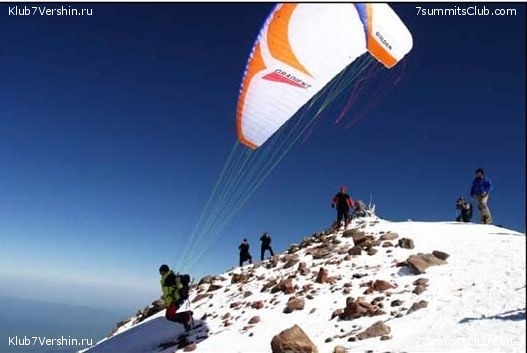
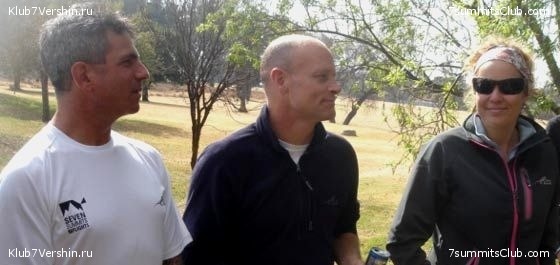
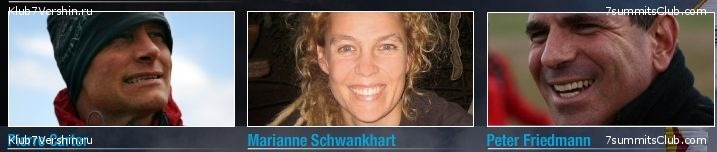
The “North Caucasus Resorts” state project presented for investors
Elbrus.
Climb Mount Elbrus with us, the best way to visit North Caucasus…. Yet another construction site has emerged in Russia, this time in the North Caucasus. A 5,000 square kilometre area is due to turn into a world-class ski ...
Climb Mount Elbrus with us, the best way to visit North Caucasus….
Yet another construction site has emerged in Russia, this time in the North Caucasus. A 5,000 square kilometre area is due to turn into a world-class ski tourist centre. Some private investors are prepared to invest money in the ambitious project, and the Russian Government has also pledged support. The “North Caucasus Resorts” project, presented at the St. Petersburg Economic Forum, has won the support of the Russian President Dmitry Medvedev.
The concept to develop tourism in the North Caucasus has been encoded “Height 5,642”, which is the height of Elbrus Mount, - the highest peak of Russia and Europe. This is one of the more impressive places the world over, where anyone enjoys staying during any season of the year. But so far tourists could basically enjoy the mountain from afar, since it is only the southern hillside that boasts minimal infrastructure that Alpine skiers and mountain climbers could use to practice their sports.
There’ve been numerous attempts to turn Elbrus into a tourist paradise, but the cost of the project has invariably proved an insurmountable barrier. But now that the Russian Government has decided to invest in the project, albeit partially, the situation has changed for the better. A decision has been made to develop infrastructure both on Mount Elbrus and in the adjacent area, which boasts an overwhelming plant life. As a result the new project comprised several resorts in six republics, namely Dagestan, North Ossetia, Karachayevo-Cherkessia, Adygea and Kabardino-Balkaria, and the Krasnodar Region.
This will help minimize the expenditure and bring the regions closer to each other, Dmitry Medvedev said, and elaborated.
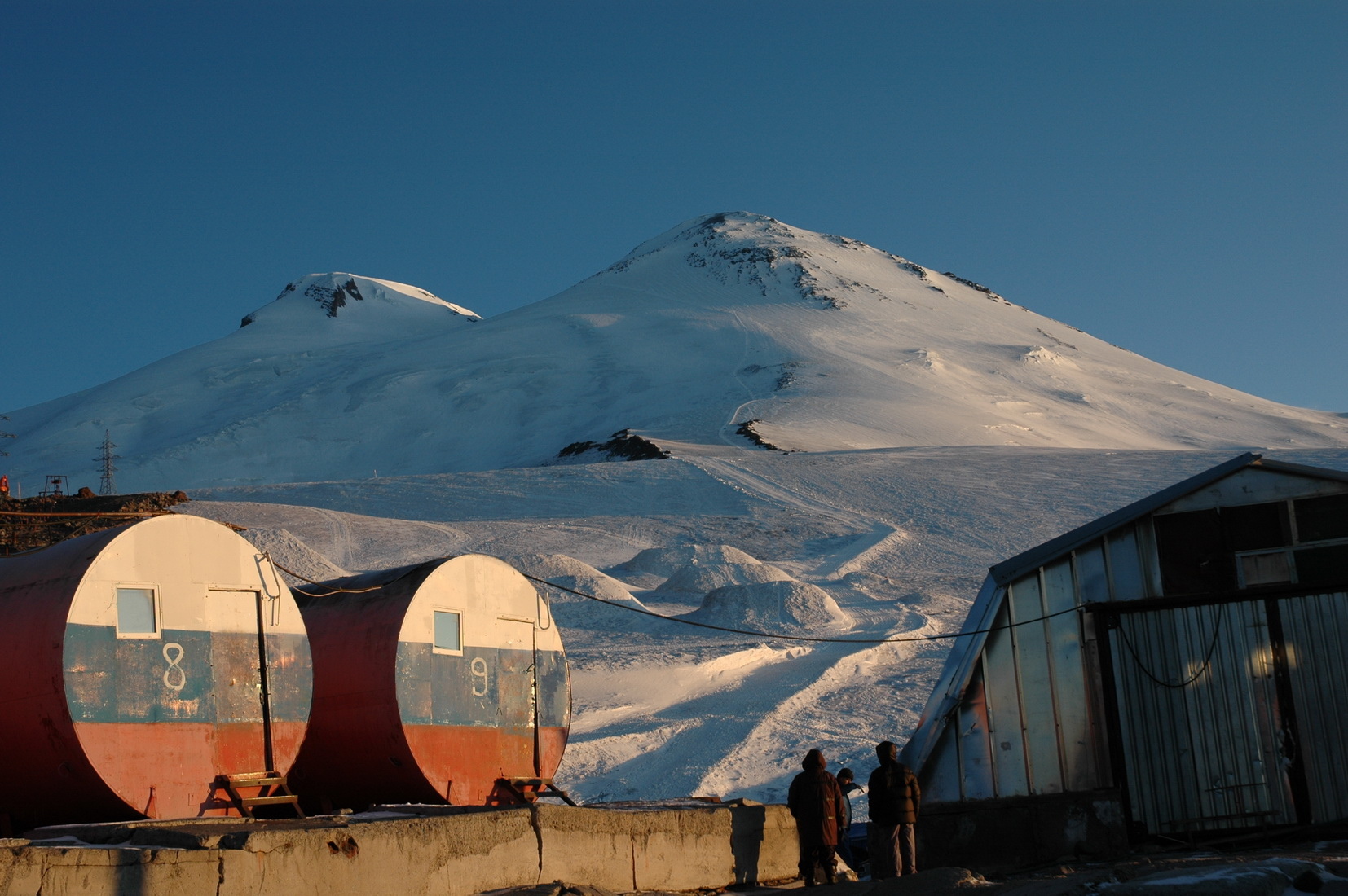
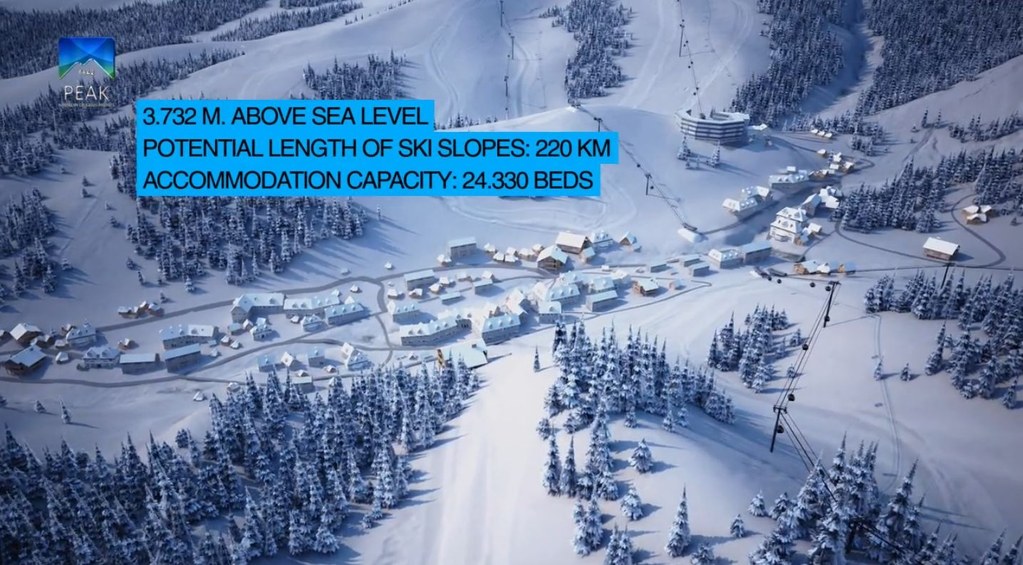
Each of these republics, Dmitry Medvedev says, has its own industry, agriculture, its own problems, but none has had the idea that would bring them together in terms of business. I am certain that if the project is carefully thought out, everything will work out nicely, and nothing can possibly prevent us from carrying it out, including security problems. I hope we will still meet at one of these resorts, Dmitry Medvedev said in conclusion.
Under the project the tourist infrastructure of the North Caucasus will be built from scratch. To make the construction site attractive to investors, each resort will get the status of a special economic area, with preferential tax treatment, loans and other preferences. The project is due to be carried out in 20 years; the original investment will make up some 40 billion roubles; which is slightly more what the Sochi-2014 Olympics project needed for implementation.
Huge funds to be invested are certainly a drawback, but the project also boasts unquestionable advantages, including the creation of new jobs. It is no secret that the mentality of the North Caucasus residents has little to do with an effective development of an industrial complex, but the service sector, restaurants and hotels, are precisely the place where local residents will be happy to work in